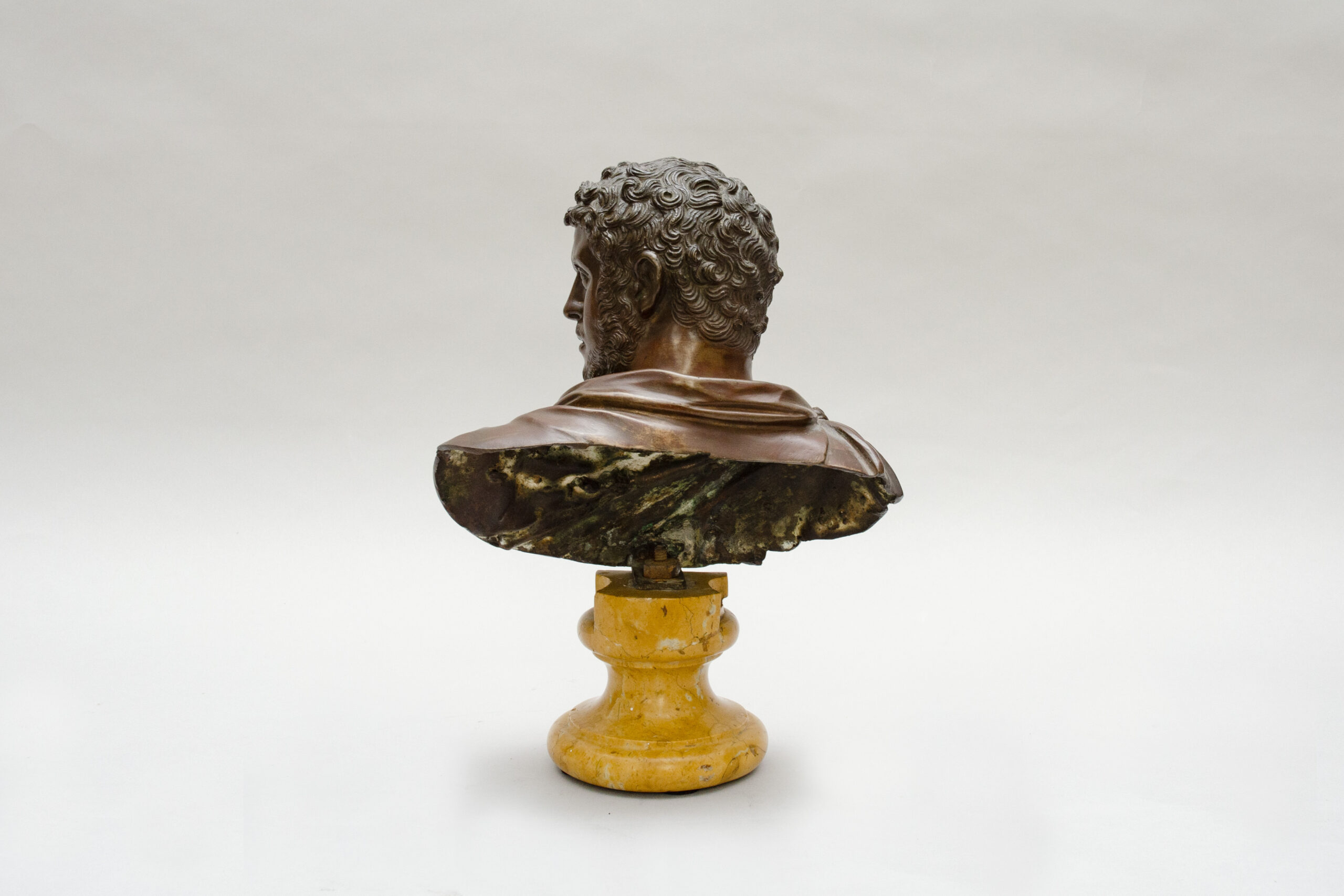
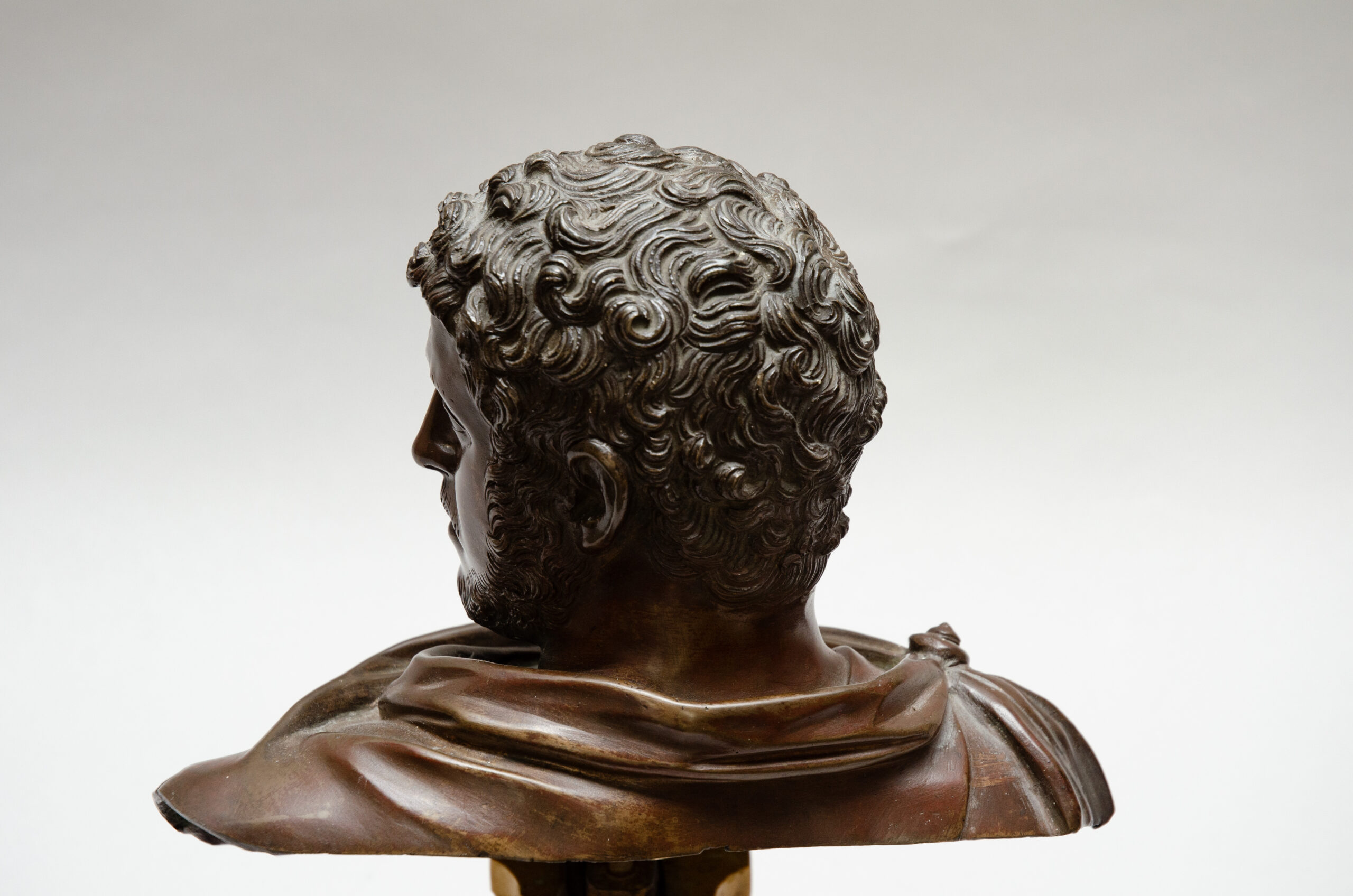
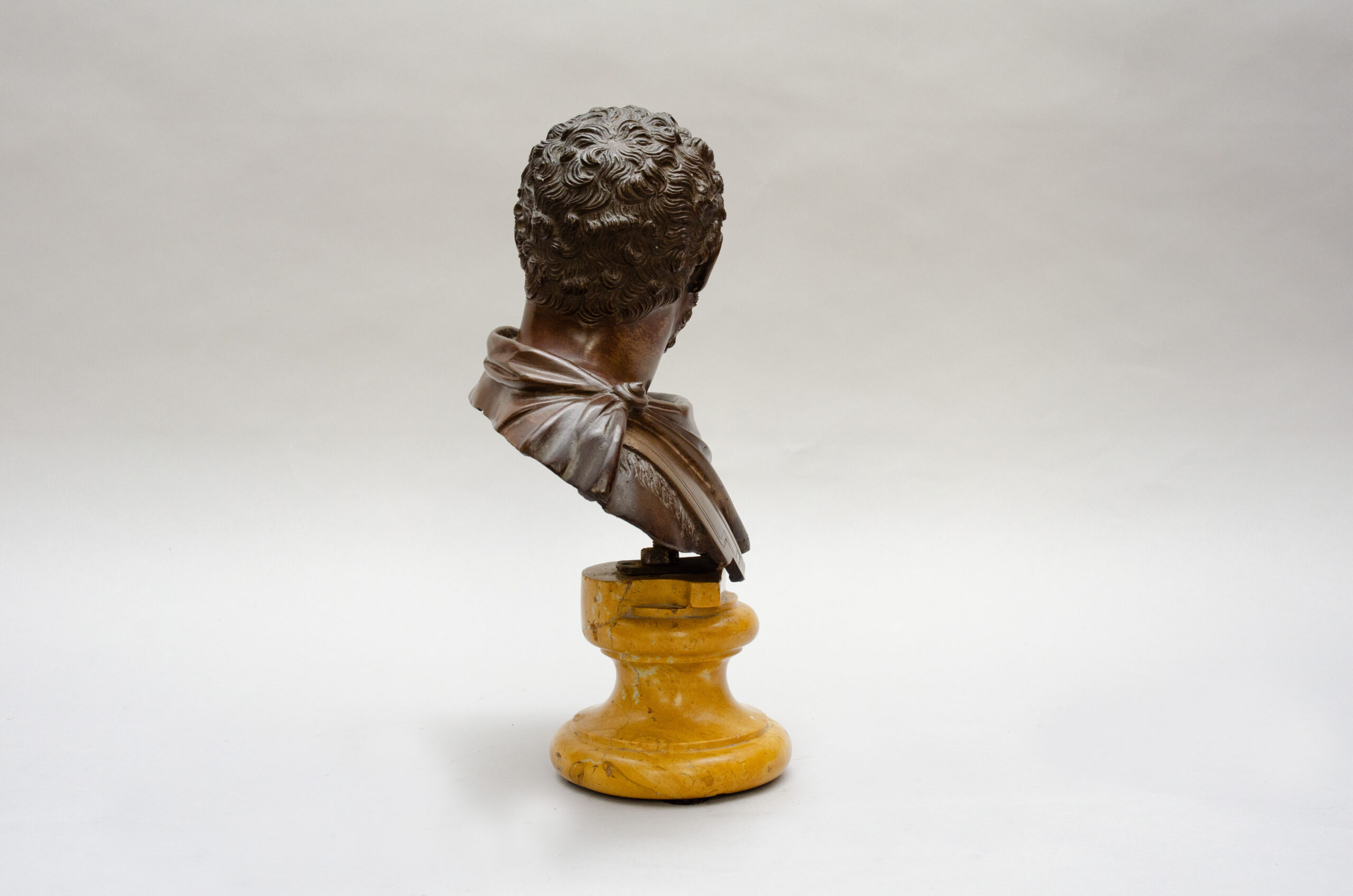
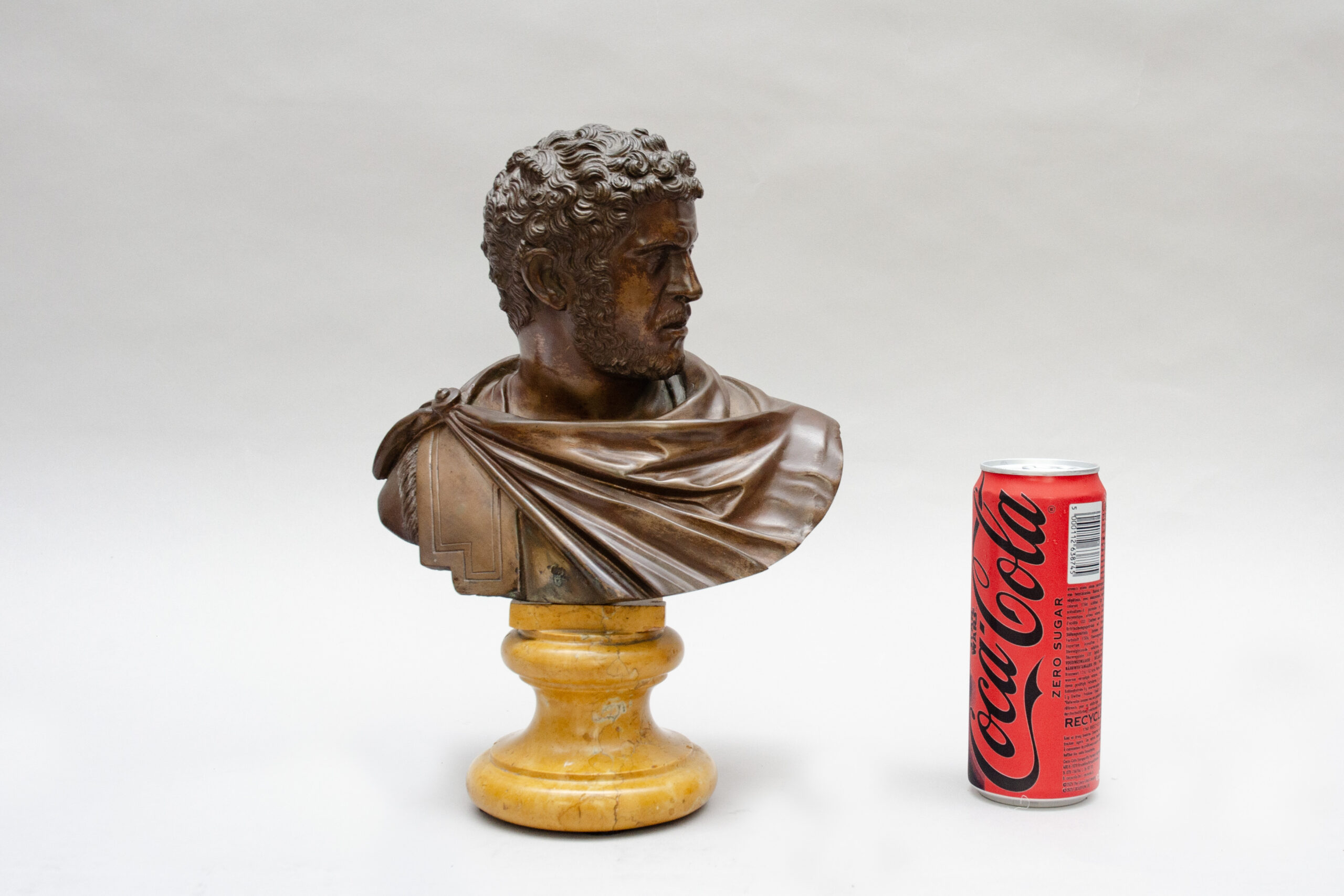
Bronze bust of Emperor Caracalla
Out of stock
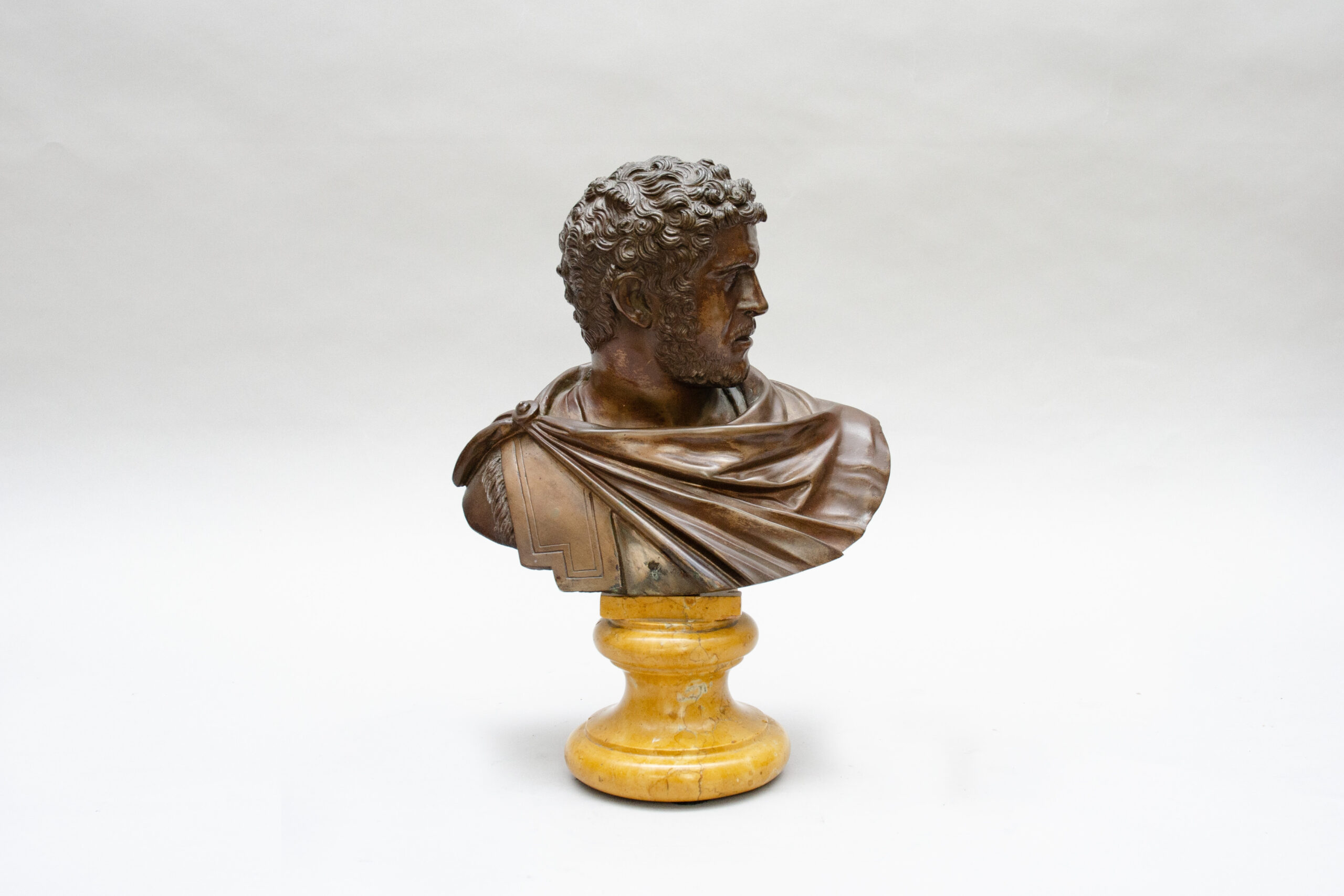
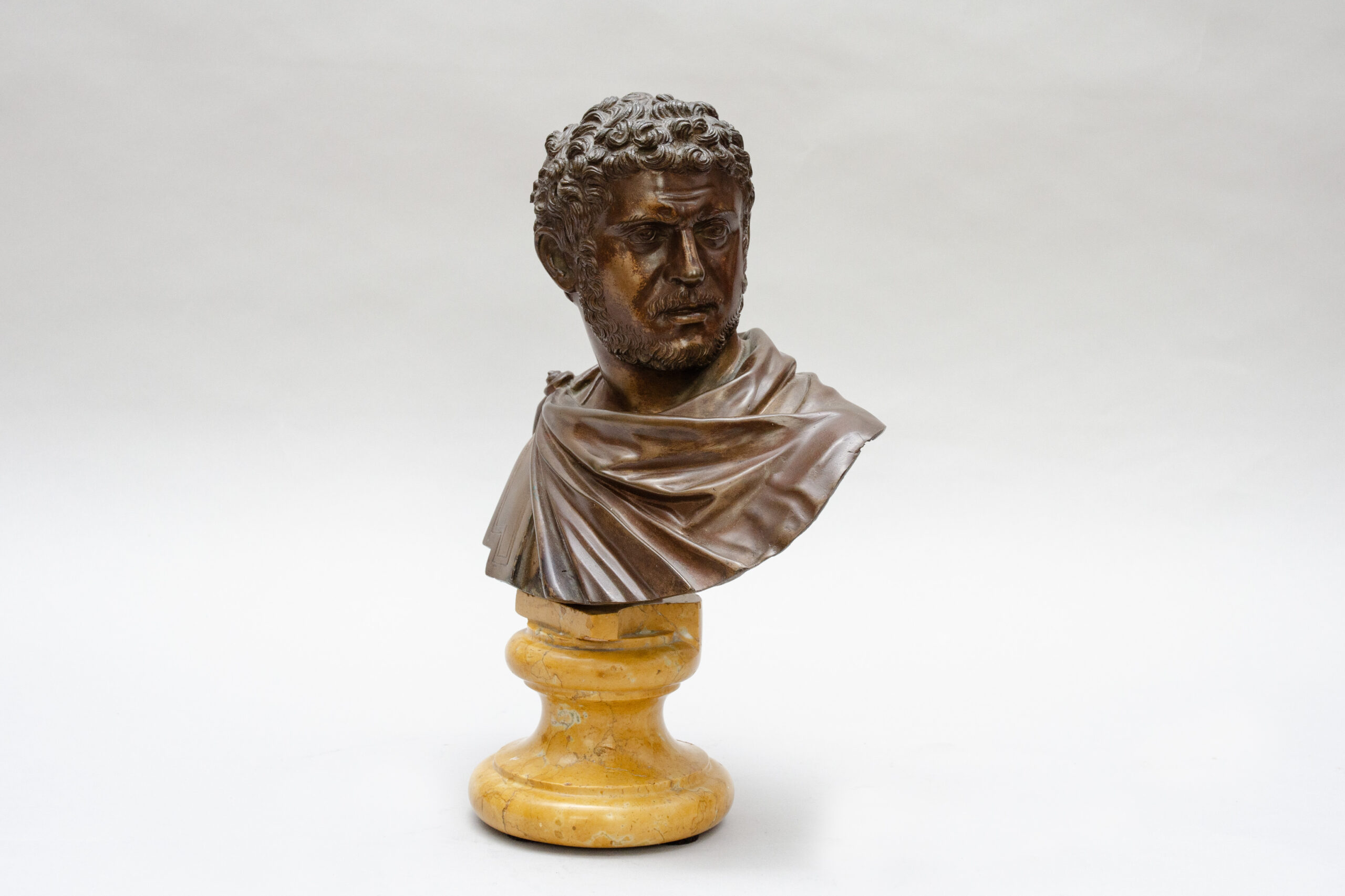
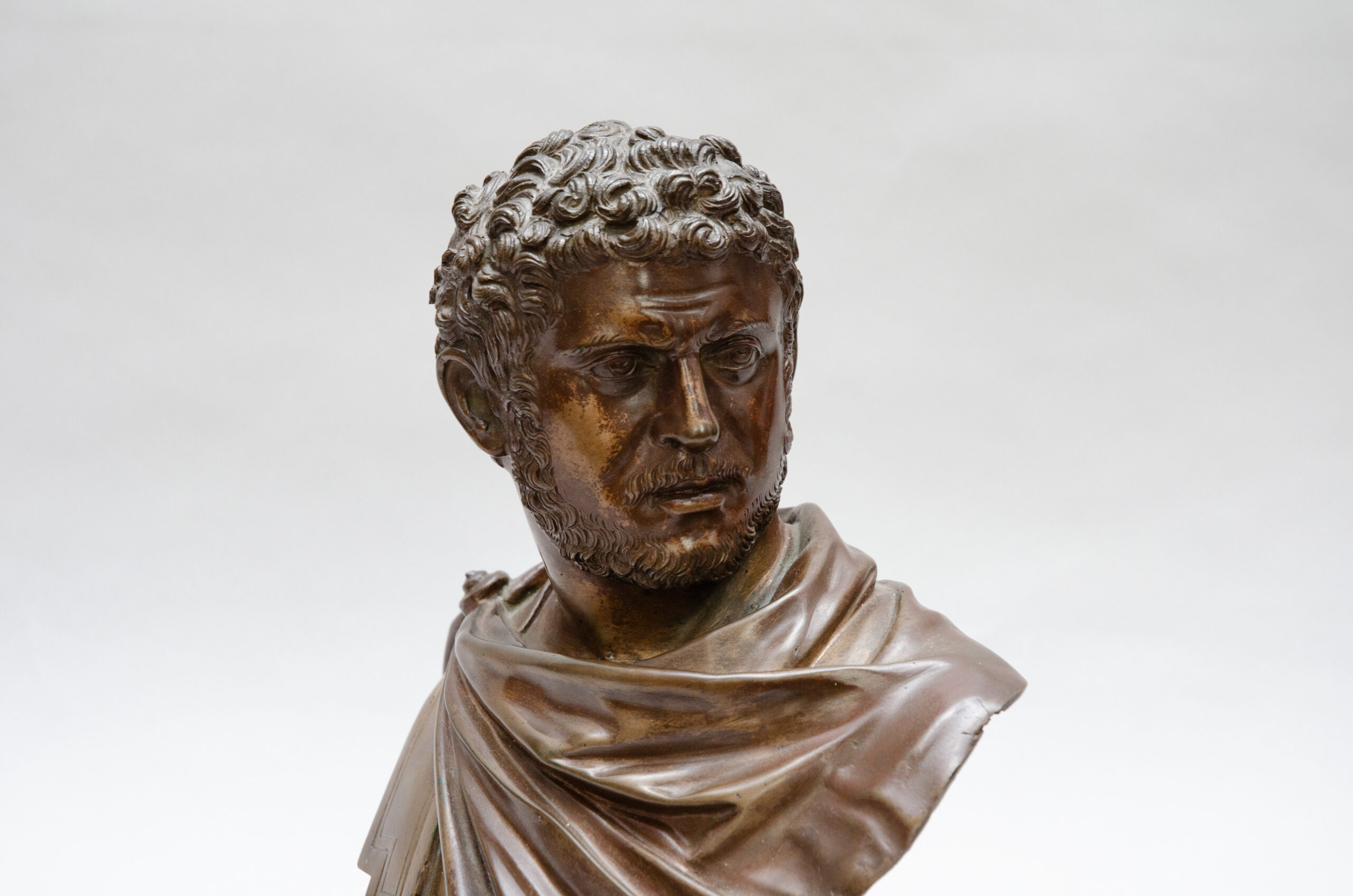
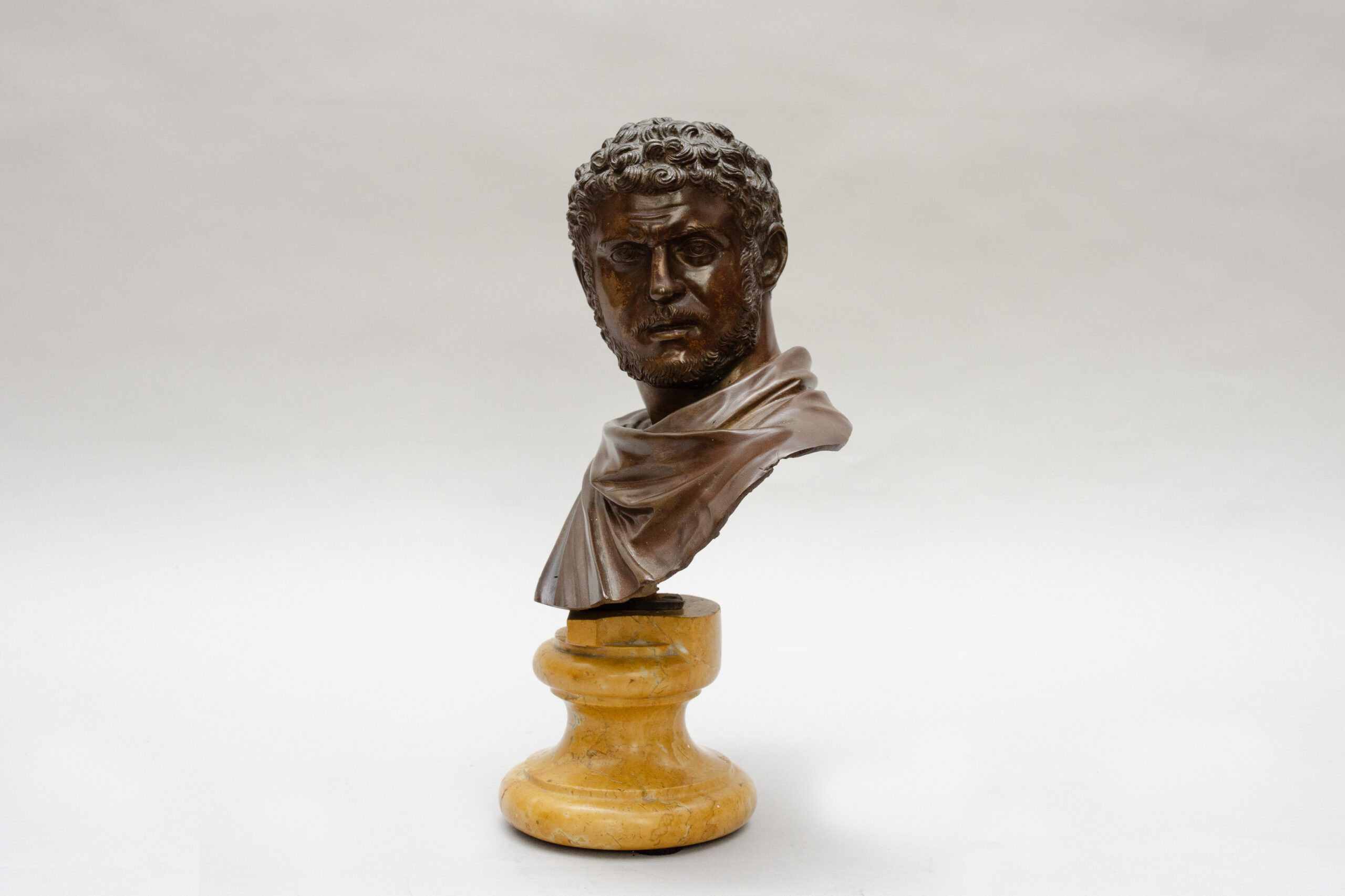
A fine bronze bust with a brown patina depicting the Roman Emperor Caracalla, draped in a paludamentum tied over his right shoulder, revealing the breastplate of a cuirass. The face, vigorous and stern, with short, finely curled hair and beard, reflects the characteristic features of imperial portraits from the Late Roman Empire. The bust rests on a pedestal of yellow Sienese marble. The bronze is hollow, with slight wear to the patina.
Dimensions: H 30 cm – W 21 cm – base diameter 10 cm
Work modelled after Antiquity, by a 19th-century sculptor and bronze caster.
Note: The portrait of Caracalla, with his low, furrowed brow, piercing gaze cast to one side and short beard, is one of the most frequently copied types in Roman imperial statuary, popularised in particular by the famous bust in the National Archaeological Museum of Naples. 19th-century bronze casters drew heavily on this ancient repertoire to offer their clients busts of Roman emperors, striking a balance between archaeological accuracy and the decorative tastes of the period.
Background: Marcus Aurelius Antoninus, nicknamed Caracalla, was born in Lugdunum (Lyon) in 188 AD. The eldest son of Emperor Septimius Severus and Julia Domna, he was granted the title of Caesar at a very young age, before becoming co-emperor with his father in 198. His nickname, Caracalla, derives from a long, hooded Gallic tunic which he favoured and popularised in Rome.
On the death of Septimius Severus in 211, Caracalla shared power with his younger brother Geta, in accordance with their father’s wishes. But the long-standing rivalry between the two brothers quickly turned into open conflict. By the end of 211, Caracalla had Geta assassinated in their mother’s arms, then ordered a ruthless damnatio memoriae, having his brother’s name and image erased from all public monuments across the Empire.
Having become the sole ruler of Rome, Caracalla reigned as an autocrat, relying above all on the army, whose pay he increased considerably. His reign was marked above all by a measure of major legal significance: the Edict of Caracalla (Constitutio Antoniniana), promulgated in 212, which granted Roman citizenship to virtually all free men in the Empire – a privilege previously reserved for a minority. This measure, the motives behind which remain a subject of debate—ranging from political generosity to a desire to broaden the tax base—brought about a lasting transformation of the social and administrative structure of the Roman world.
Architecturally, Caracalla left Rome one of the most impressive monuments of antiquity: the Baths of Caracalla, vast thermal complexes inaugurated around 216, capable of accommodating several thousand bathers and adorned with mosaics, statues and sumptuous marble, the impressive remains of which can still be visited today.
Caracalla’s reign was also marked by brutality and instability: bloody crackdowns, notably the massacre of the inhabitants of Alexandria in 215 in retaliation for mockery directed at him, and an aggressive foreign policy focused on the East, where he dreamt of equalling the conquests of Alexander the Great.
It was during a military campaign against the Parthians that Caracalla met his death, assassinated on 8 April 217 near Edessa (in present-day Turkey) by one of his own guards, Justin Martialis, at the instigation of the praetorian prefect Macrinus, who immediately succeeded him to the imperial throne.
Posterity has retained a mixed image of Caracalla: that of a cruel and impulsive ruler, but also that of an emperor whose edict of 212 left a profound mark on the history of Roman law, and whose energetic face, immortalised in ancient statuary, remains one of the most recognisable imperial portraits in Roman art.
Out of stock