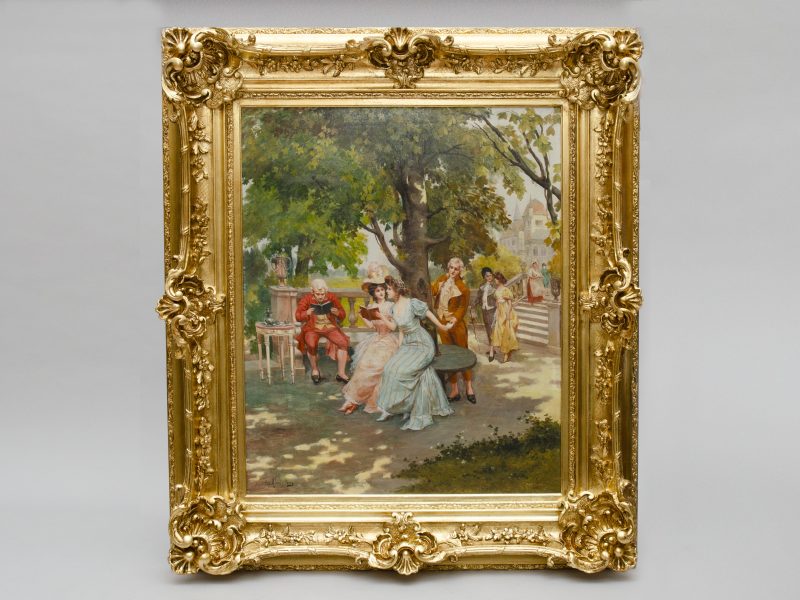
“Female nude” drawing by Auguste Oleffe (1867-1931), belgian school
Price on request
Contact usSeated female nude, charcoal drawing on kraft paper, signed and dated 1915 in the bottom right-hand corner. Period frame in blackened and gilded wood, with slats left in their natural wood finish beneath the glass, lending depth to the work. This charcoal drawing depicts a seated nude woman, captured in a classical three-quarter rear view pose. The model, turned slightly to the left, reveals the curve of her shoulder and bust, whilst her hair, pulled back, reveals a delicate nape of the neck. The supple, enveloping application of the charcoal testifies to Auguste Oleffe’s mastery in the study of the female form: the shadows are subtly blended, the volumes suggested with economy of means, and the light seems to caress the model’s skin. The work as a whole exudes an intimate and poetic atmosphere, characteristic of the artist’s sensibility.
Size: H 33 cm x W 25 cm – H 50 cm x W 43 cm
The work is presented in its original wooden frame, which highlights the delicacy of the drawing and lends it a museum-quality presence. On the reverse is a label confirming its inclusion in the artist’s retrospective at the Rouge-Cloître in 1979. Stamp from the Lismonde gallery in Beersel confirming the work’s inclusion in a retrospective in 1989.
Biography: Auguste Charles Louis Oleffe was born in Brussels in 1867. He trained at the Saint-Josse-ten-Noode School of Drawing and subsequently at the Académie libre L’Effort, a progressive artistic circle that encouraged experimentation. After completing his studies, he worked as a lithographer and draughtsman, before moving to Paris in 1890 to refine his technique whilst engaging with the French avant-garde. On his return to Belgium, Oleffe developed a personal style that blended the legacy of Impressionism with bold experiments in colour. A painter of figures, portraits, still lifes and landscapes, he also excelled in etching and drawing. His genre scenes, often imbued with tenderness, and his harbour views of Ostend reveal a sensitive perspective on everyday life. Associated with the Brabant Fauvism movement, Oleffe shared with his peers a taste for expressive colour and the simplification of forms, whilst maintaining a more nuanced style than that of the French Fauves. He exhibited regularly in Belgium and built up a solid reputation amongst collectors. He died in Saint-Josse-ten-Noode in 1931, leaving behind a prolific body of work that continues to captivate the art market.
Lit: Brabant Fauvism: Colour Unleashed,
At the turn of the 20th century, whilst Henri Matisse and André Derain were ‘unleashing’ colour on the shores of Collioure, a parallel movement emerged in Belgium, in the Brabant region. It is now known as Brabant Fauvism.
The artists who formed this movement – including Rik Wouters, Ferdinand Schirren, Auguste Oleffe, Jean Brusselmans and Willem Paerels – shared with their French counterparts a common desire to break away from academic naturalism. Colour was no longer subservient to a faithful depiction of reality: it became a vehicle for emotion, an autonomous language. Pure tones, applied in vibrant brushstrokes, convey light and atmosphere rather than mere appearances.
Yet Brabant Fauvism is distinguished by a sensibility all its own. The exuberance of the Parisian ‘Fauves’ is tempered here by a certain restraint, a more intimate lyricism, perhaps inherited from the pictorial tradition of the former Netherlands. Their favourite subjects remain rooted in everyday life: bourgeois interiors bathed in light, gardens in bloom, portraits of loved ones, and feminine nudes imbued with gentleness. The brushwork, whilst free, often retains a legible structure, a concern for form that testifies to an attachment to the human figure and to the modelling of the form.
Rik Wouters, a central figure in the movement, embodies this joy of painting combined with an evident tenderness for his favourite model, his wife Nel. Auguste Oleffe, a more reserved artist, brings to the group a mastery of drawing and a luminous palette, oscillating between late Impressionism and the boldness of the Fauves. Ferdinand Schirren, for his part, pushed chromatic experimentation to the point of creating surprising harmonies, whilst Jean Brusselmans moved towards a geometric simplification that foreshadowed Expressionism.
Brabant Fauvism flourished mainly between 1905 and 1914, before the Great War scattered or claimed the lives of its leading figures. Rik Wouters died in 1916, aged just thirty-three. Despite its brevity, the movement left a lasting mark on 20th-century Belgian art: it paved the way for Flemish Expressionism and demonstrated the Belgian art scene’s ability to engage on equal terms with the European avant-garde.
Today, the works of the Brabant Fauvists are held in Belgium’s major museums – the Ixelles Museum, the Royal Museum of Fine Arts in Antwerp, and the Museum of Fine Arts in Ghent and are sought after by collectors for their freshness, vitality and incomparable luminosity.