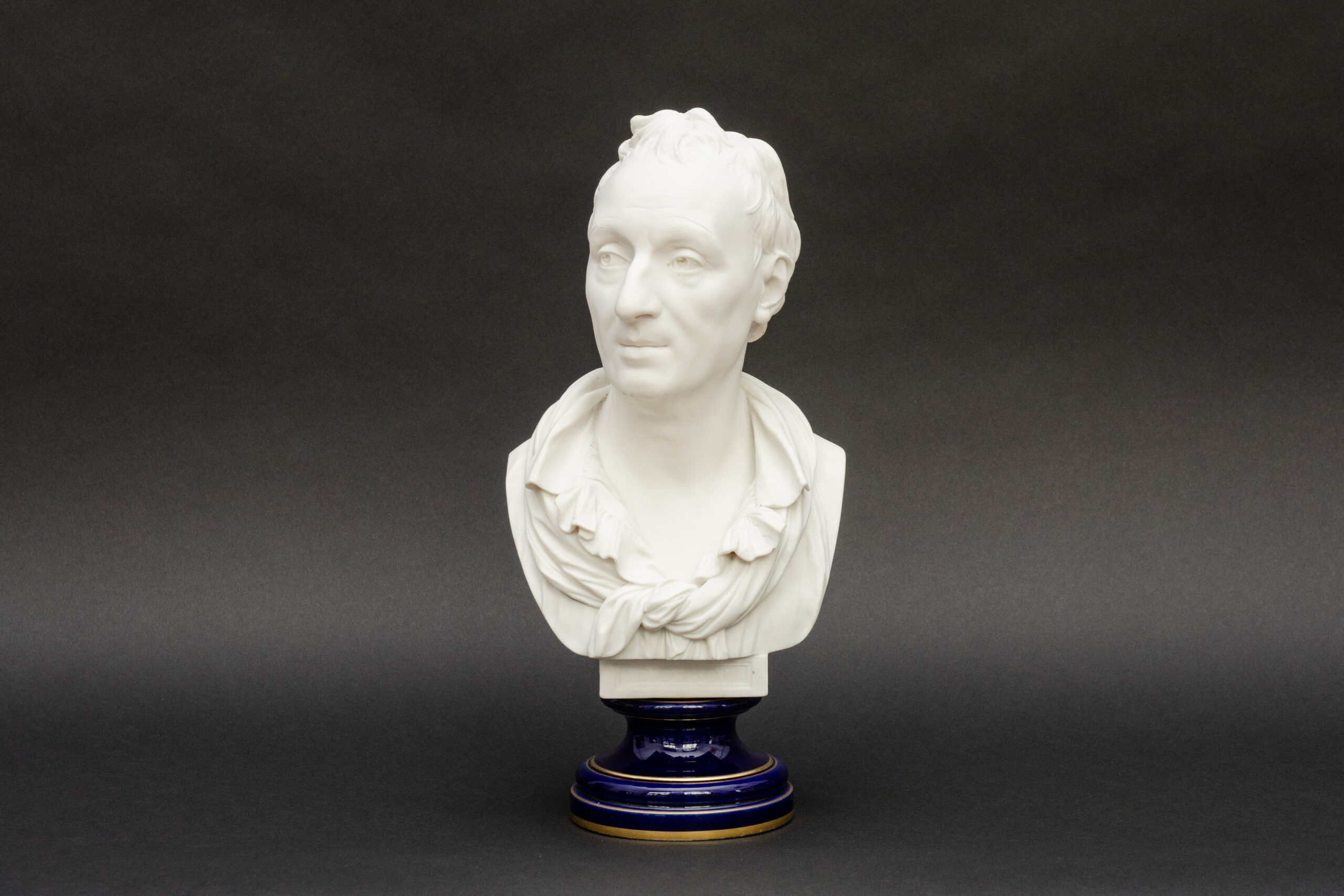
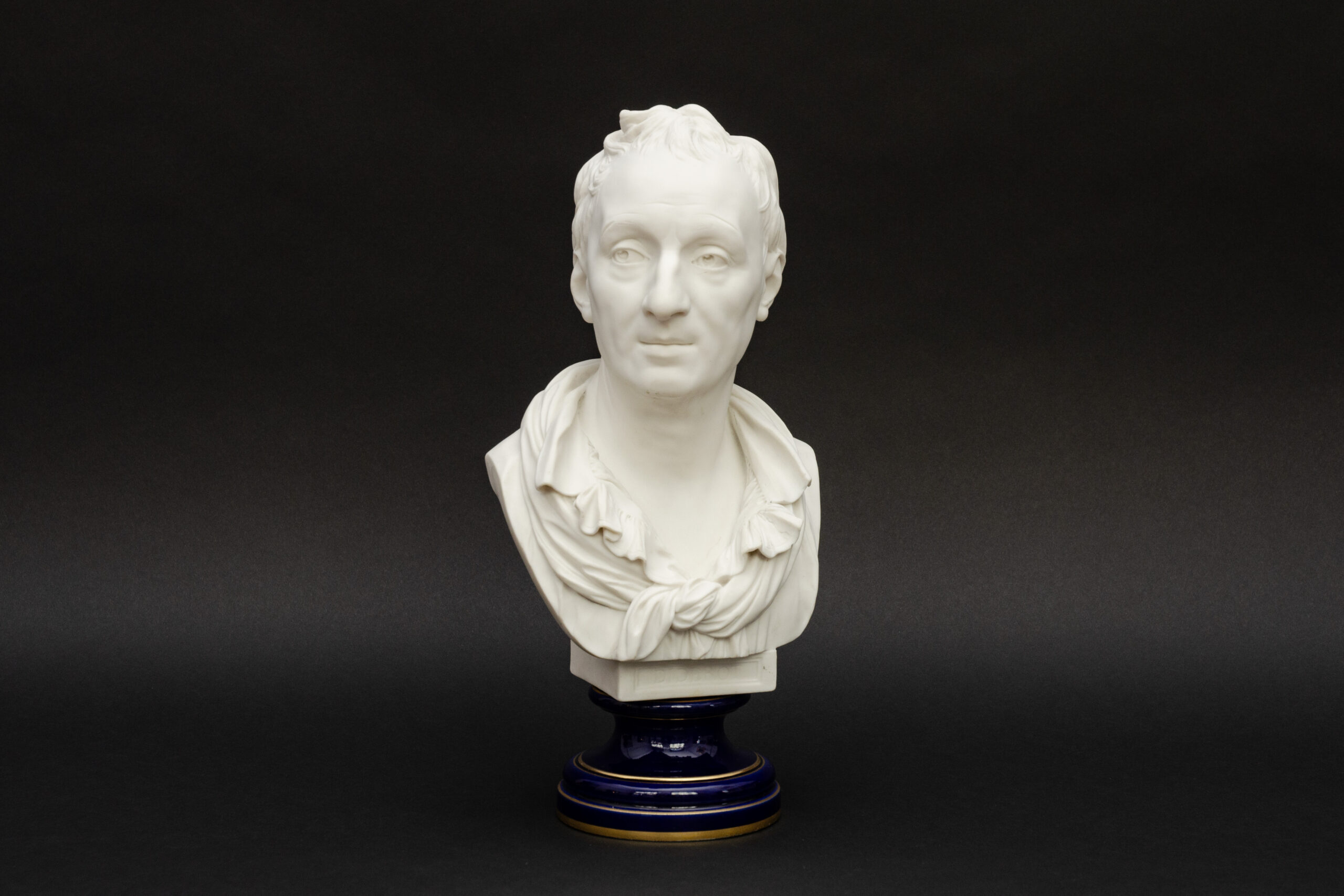
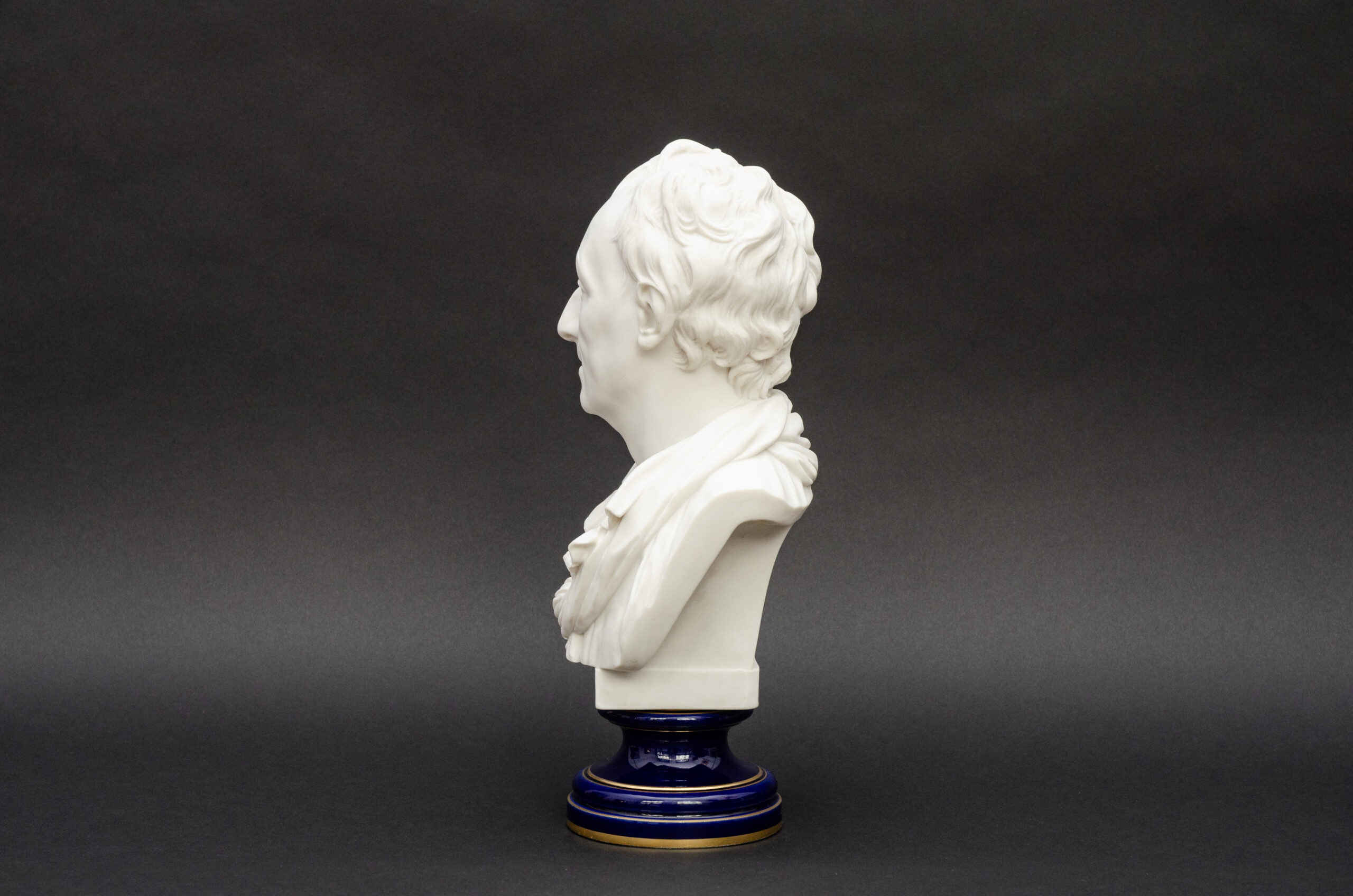
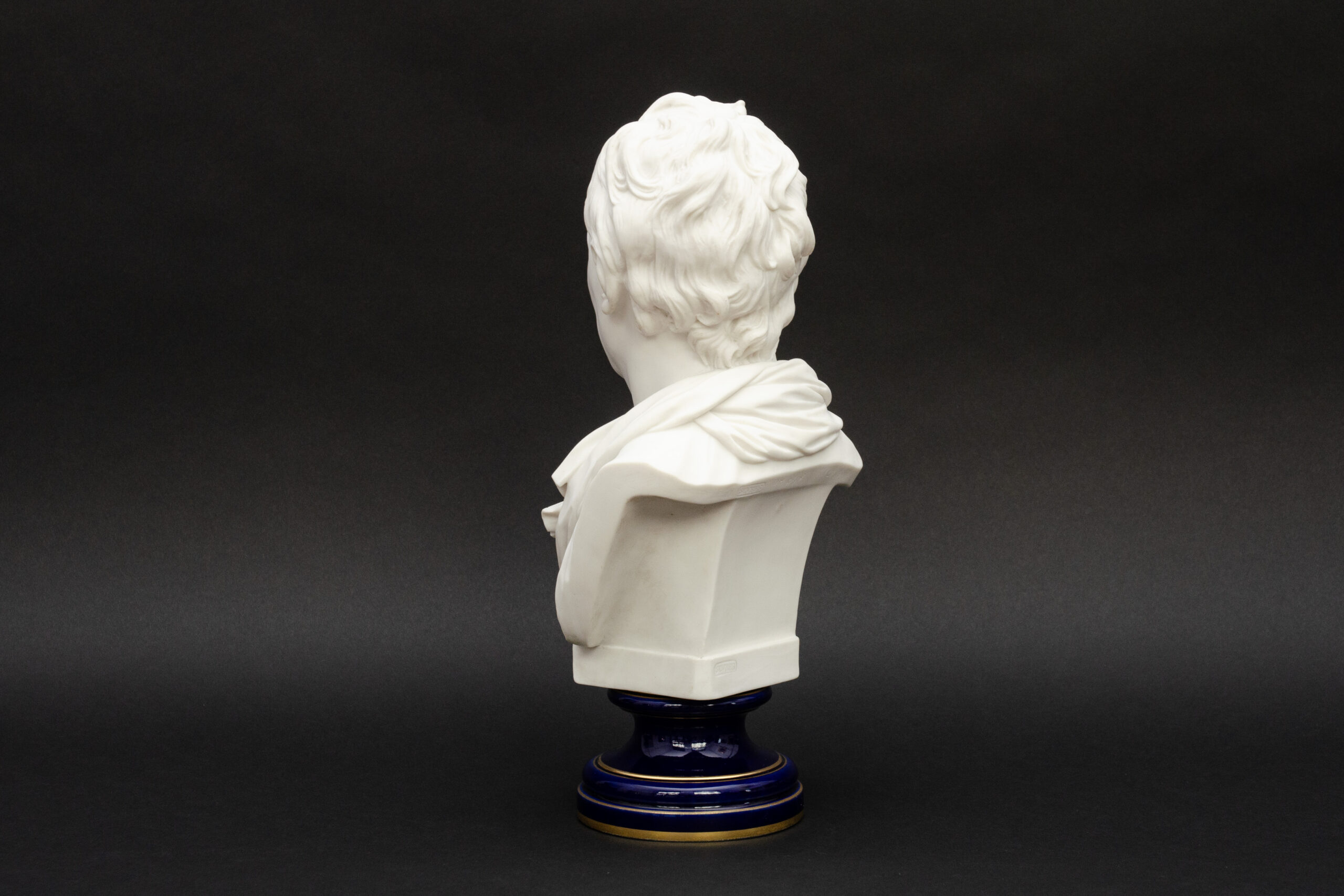
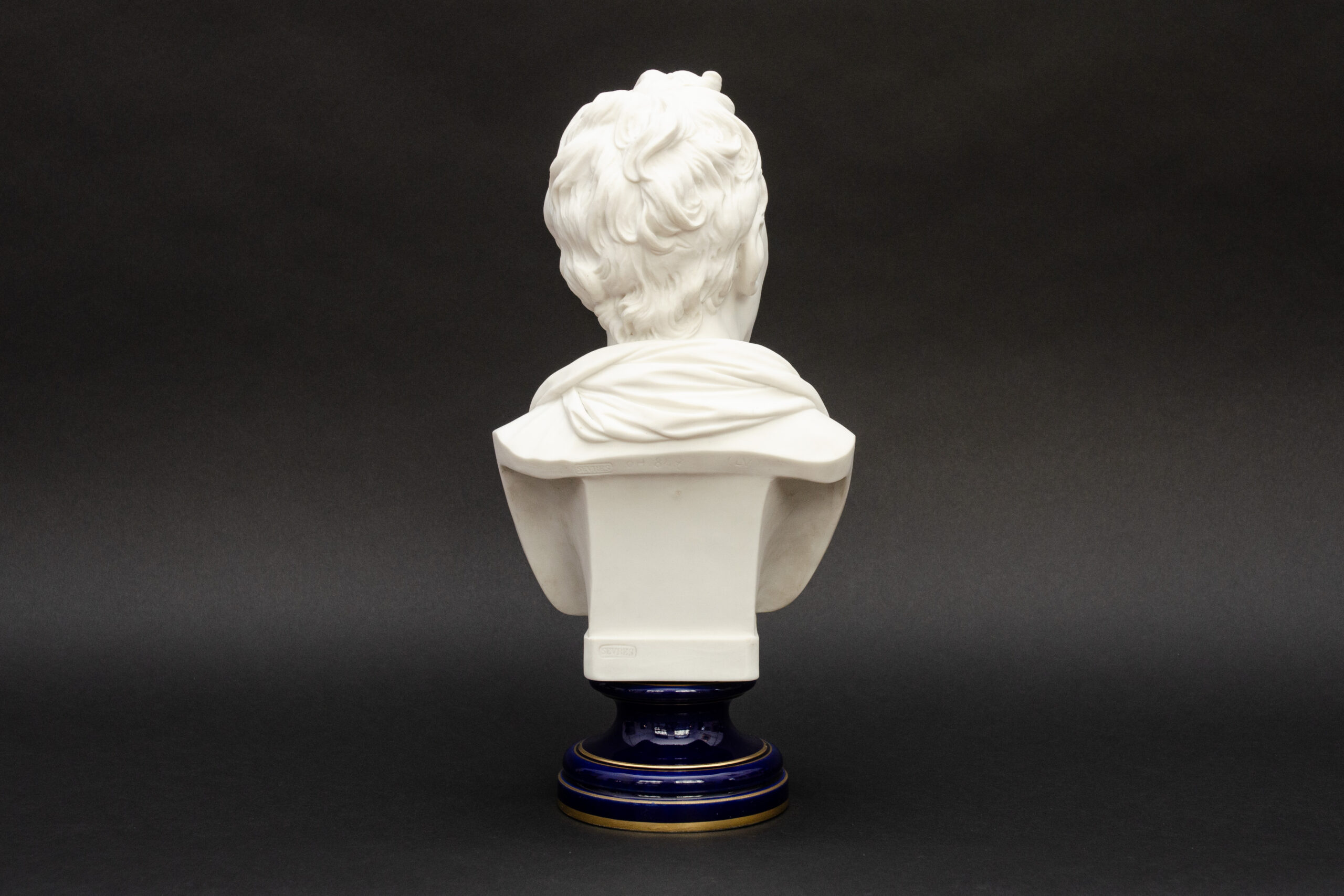
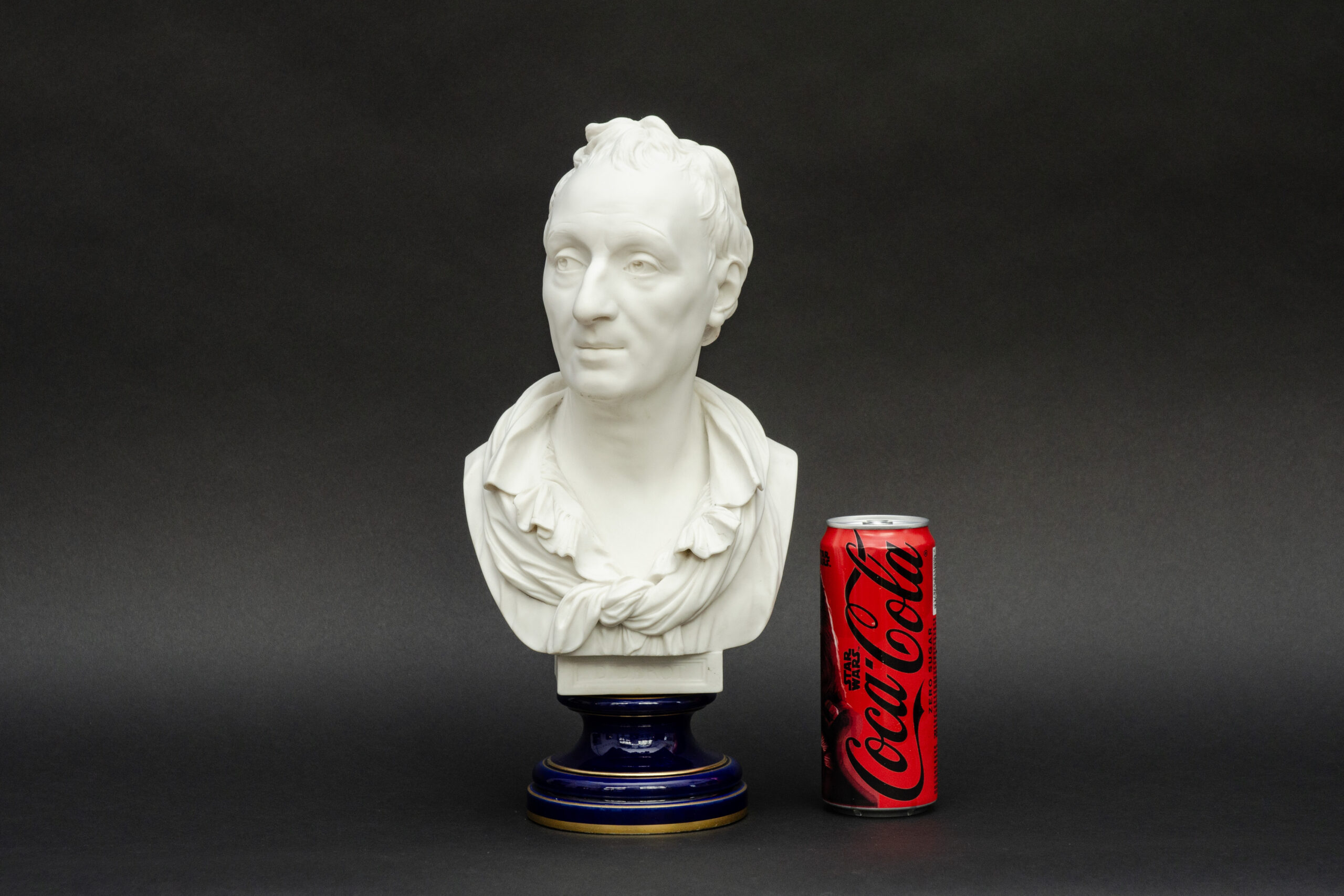
“Diderot”, bisque and porcelain bust, Sèvres manufactory
Price on request
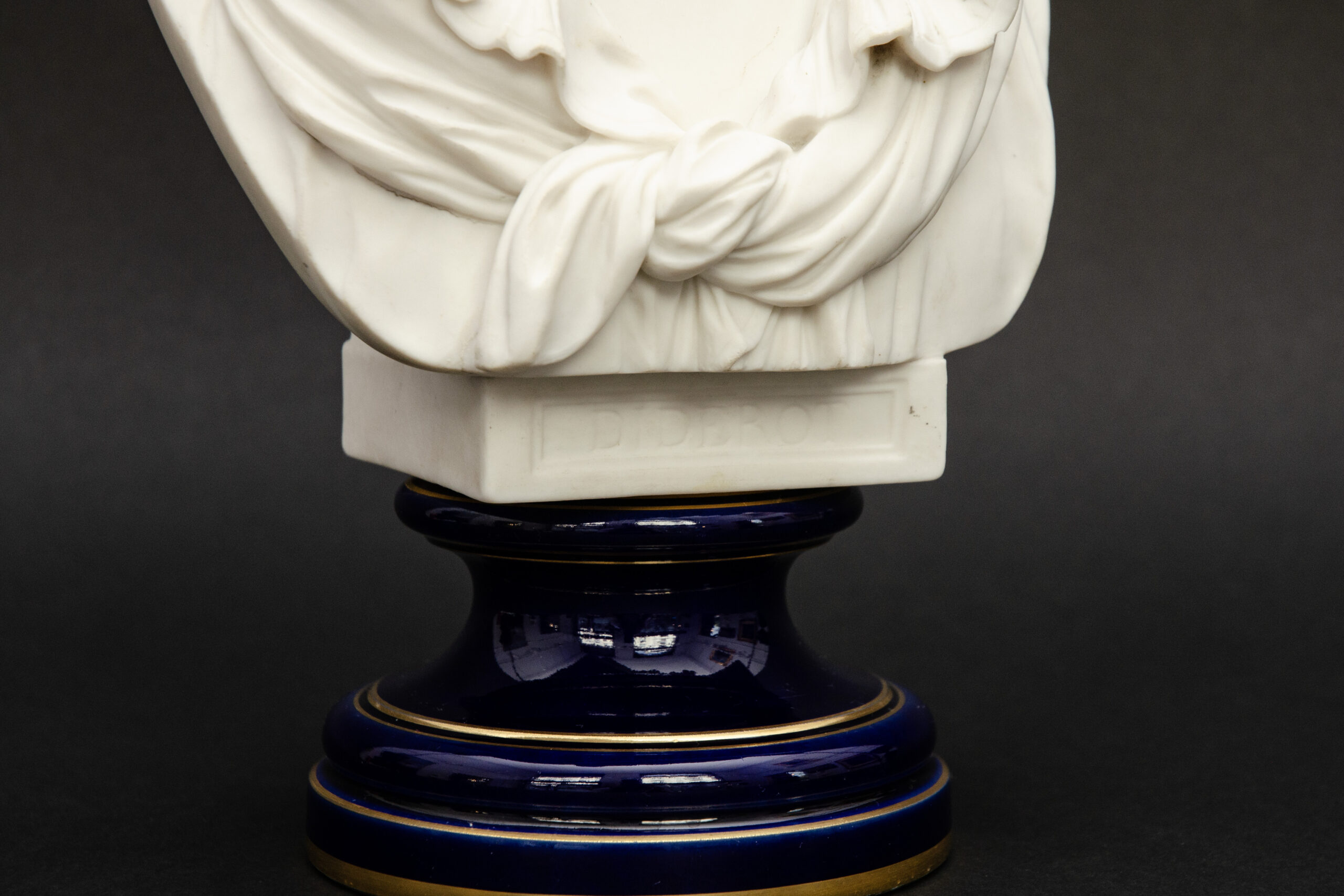
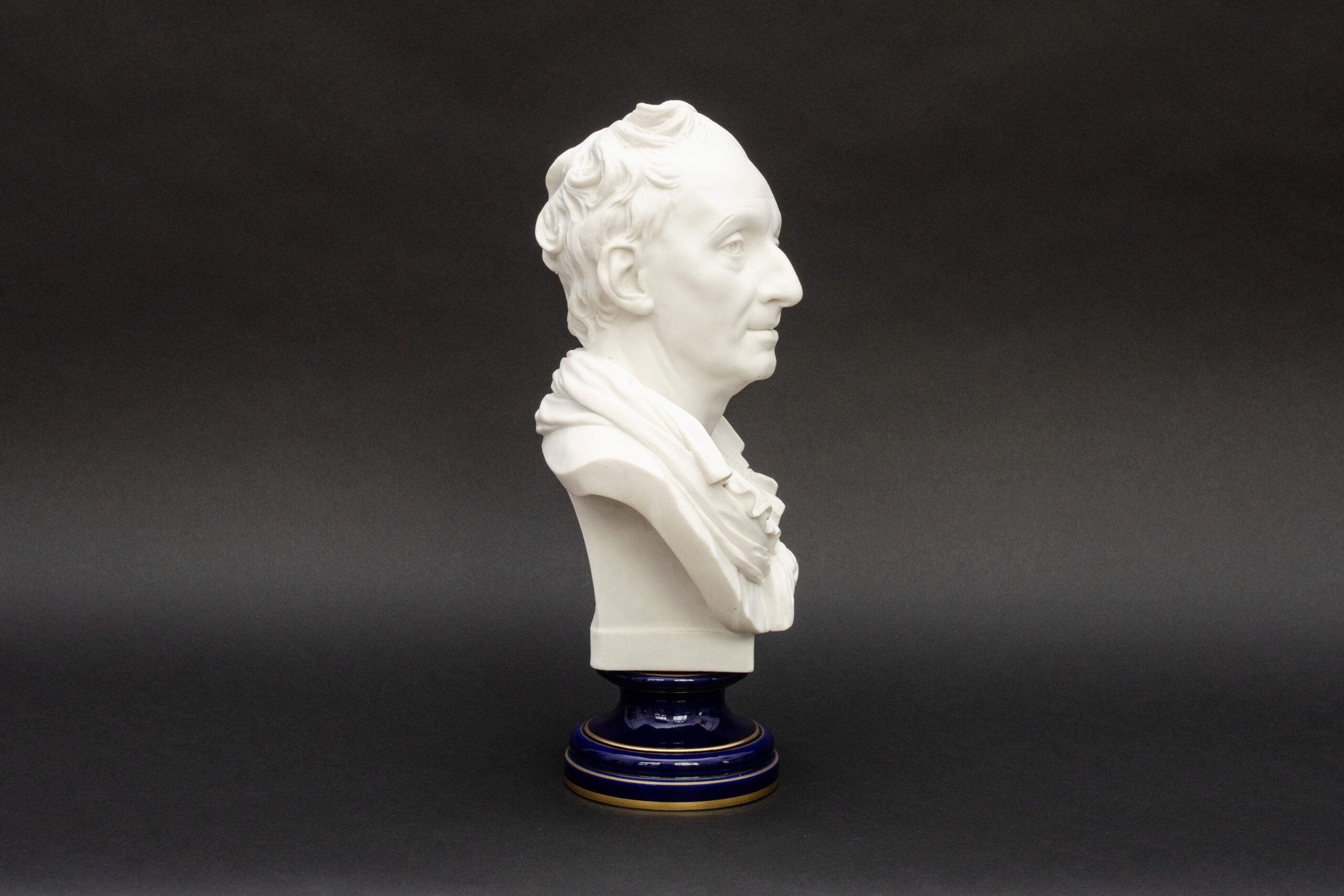
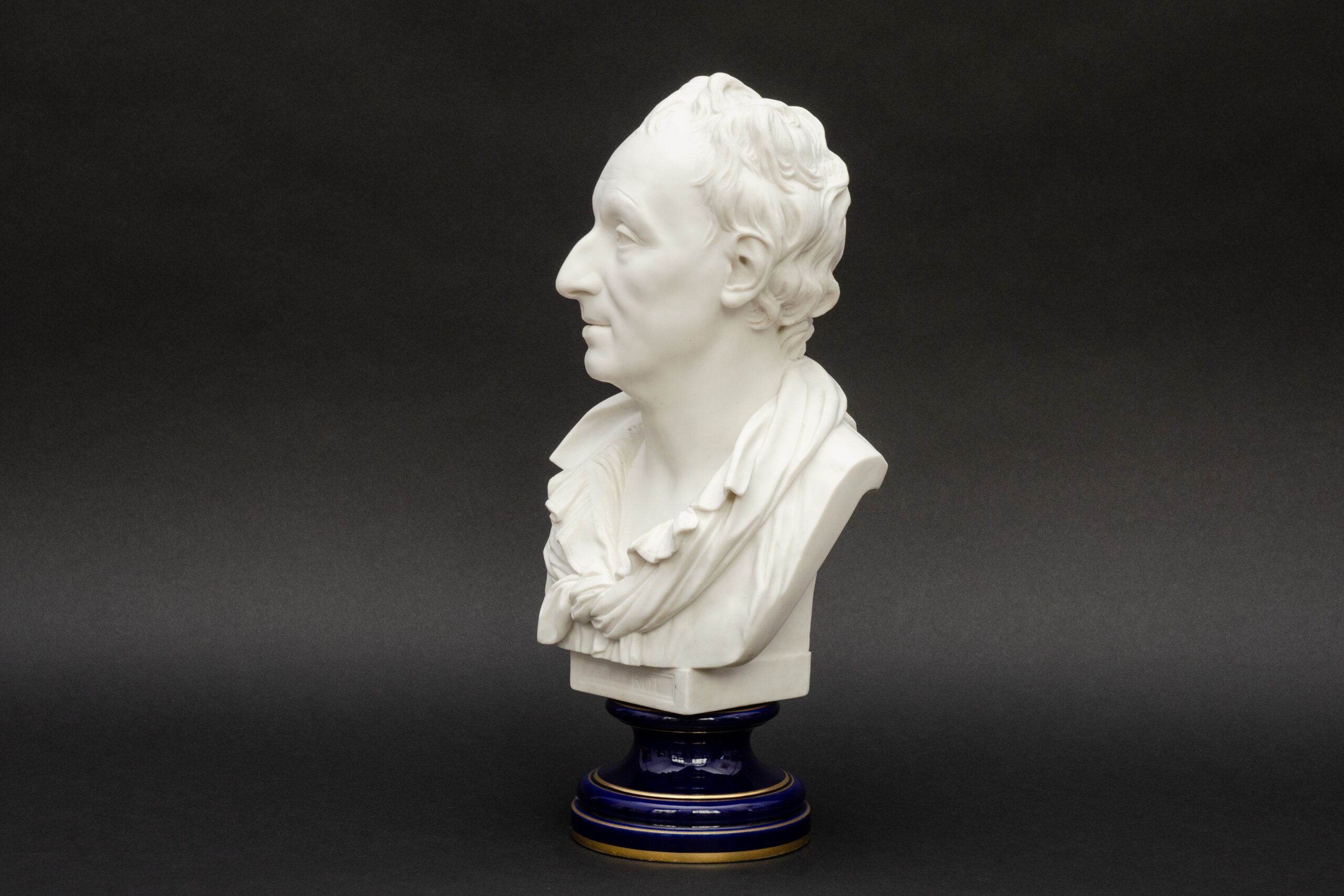
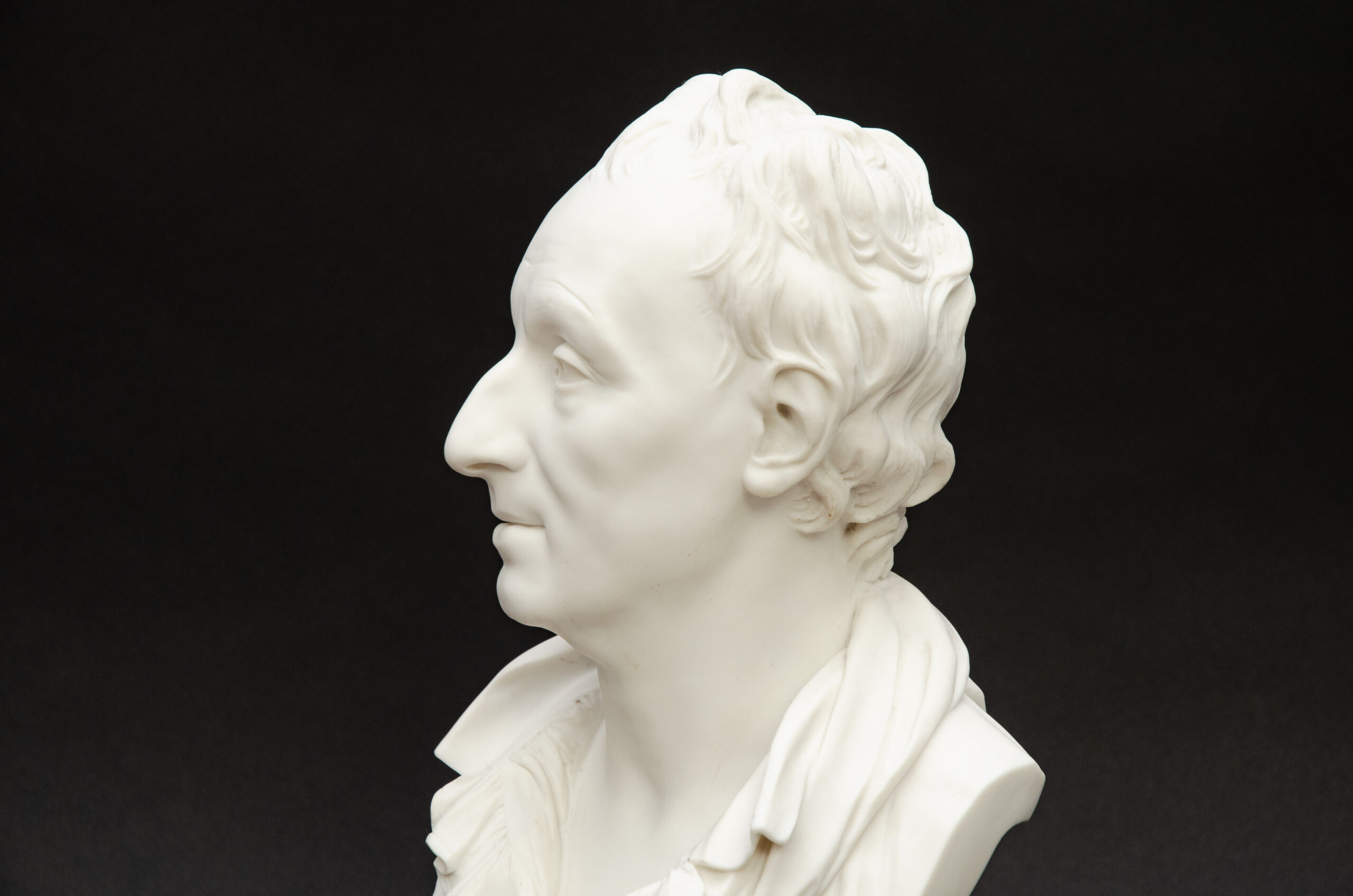
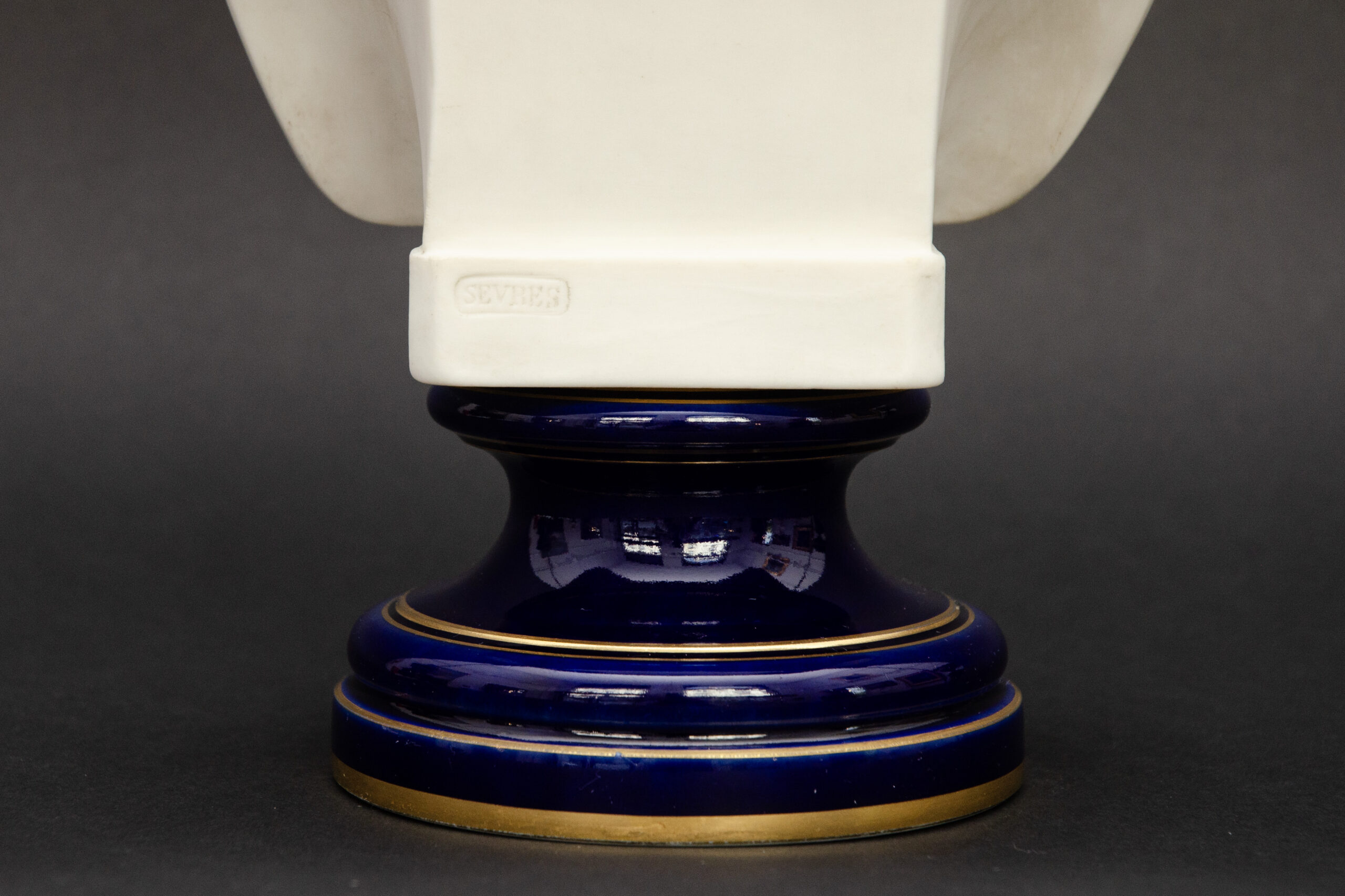
Contact usA bust portrait of the philosopher Denis Diderot in hard bisque porcelain, resting on a pedestal of deep cobalt-blue glazed porcelain, accented with gold fillets. The philosopher is depicted with his head turned to his left, in a lively gesture that breaks with the conventional frontal pose and lends the portrait its full presence. The face, captured in his mature years, combines a sharp gaze with a half-smile of restrained irony: a high, clear forehead, pronounced brow ridges, prominent cheekbones, hollowed cheeks and thin lips. The hair, rendered in loose strands swept back, departs from the conventional wig, a sign that this is a portrait of a ‘man of letters’ rather than a man of the court. The bust is clad in a finely crafted shirt with a lace frill, wide open at the chest, and a loose, draped cloak tied in a sash: a neoclassical style that draws the philosopher closer to ancient busts whilst retaining modern sartorial detail. The bust rests on a rectangular, moulded plinth with a recessed section bearing the inscription ‘Diderot’, which in turn is mounted on the pedestal. The contrast between the velvety matt finish of the bisque and the luster of the cobalt blue with gold highlights is one of the most sought-after effects in Sèvres’ sculptural output.
Size: H 36 cm – width at shoulders 17 cm – base diameter: 11 cm
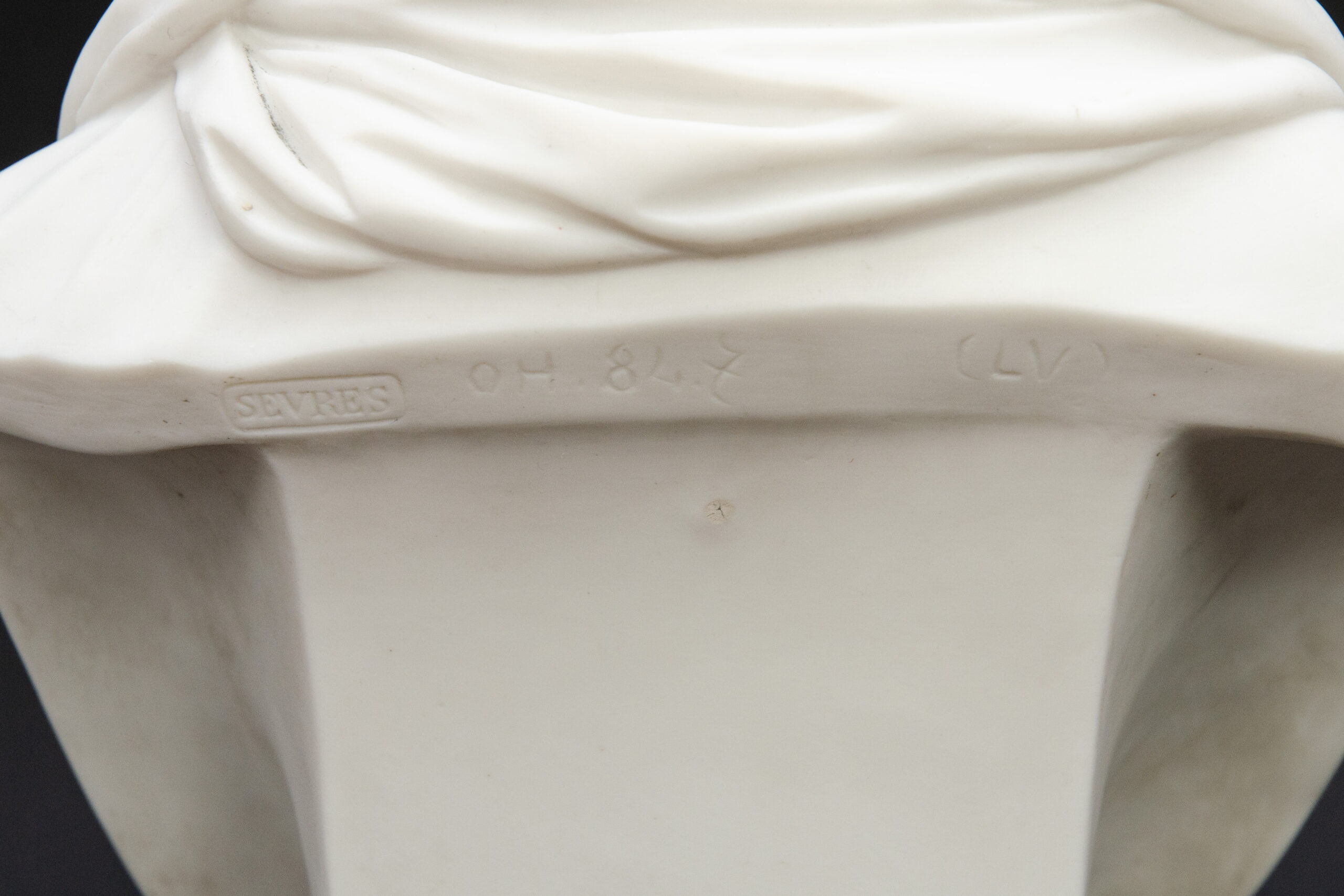
Sèvres, dated 1884 on the bisque, pedestal dated 1881 and gilded in 1884. (100 years after Diderot’s death)
The sculpted portrait of Diderot belongs to a clearly identifiable lineage: the effigies of the philosopher created during his lifetime by Marie-Anne Collot, a pupil of Étienne-Maurice Falconet, followed by the famous version by Jean-Antoine Houdon (1771). The Sèvres Manufactory holds in its storerooms a terracotta model of Diderot, a studio model that served as the basis for the bisque edition. The bust forms part of the major series of ‘Illustrious Men’ and ‘Great Men’ produced by Sèvres: philosophers, scholars, writers and statesmen rendered in biscuit porcelain on an enamelled pedestal, intended for private collections, libraries and diplomatic gifts. The mounting on a kiln-blue pedestal enhanced with gold is characteristic of these editions.
Background: Biscuit porcelain was invented in Vincennes around 1751 and developed at Sèvres under Falconet’s direction. Biscuit porcelain is unglazed porcelain, whose fine, matt texture imitates statuary marble. With no glaze to conceal imperfections, it allows for neither retouching nor repair: each piece is removed from the mould, repaired by hand one by one, then fired at a very high temperature, resulting in a considerable loss rate. This is what makes biscuit porcelain the most demanding – and the most prestigious – production of the manufactory.
Biography: Denis Diderot (1713–1784), born in Langres on 5 October 1713 into a family of master cutlers, was educated by the Jesuits before moving to Paris, where he abandoned the ecclesiastical career his father had intended for him in favour of a precarious life as a man of letters. His early years were spent as a penniless translator and prolific writer, befriending Rousseau and Condillac. His life took a dramatic turn in 1747 when, together with the mathematician d’Alembert, he took charge of the *Encyclopédie, or Reasoned Dictionary of the Sciences, Arts and Trades*. What began as merely the translation of an English dictionary became, under his guidance, the major intellectual undertaking of the century: seventeen volumes of text and eleven of plates, published between 1751 and 1772, involving more than one hundred and fifty contributors (Voltaire, Montesquieu, Rousseau, Buffon, Quesnay). Diderot himself wrote thousands of articles for it and visited workshops to describe the trades, elevating manual labour to the status of knowledge worthy of being passed on. The Enlightenment found its monument here: knowledge freed from authority, subject to the scrutiny of reason. The price was high. Imprisoned at Vincennes from 1749 onwards for his *Letter on the Blind*, censored, stripped of his printing privilege in 1759, and abandoned by d’Alembert, Diderot carried on alone, working for twenty-five years under the constant threat of a ban. This public body of work conceals another, even more daring one, which he kept in his drawers and for the ‘Correspondance littéraire de Grimm’: ‘Rameau’s Nephew’, ‘Jacques the Fatalist’, ‘The Nun’, ‘d’Alembert’s Dream’, ‘The Paradox Concerning the Actor’. A materialist and a virtuoso of dialogue, he invented a free form in which fiction serves philosophical experimentation. He was also the founder of modern art criticism through his *Salons*, in which he commented on Chardin, Greuze and Falconet — whose pupil, Marie-Anne Collot, sculpted his portrait, which served as the model for the bust still produced by Sèvres. In 1765, Catherine II of Russia purchased his library to provide him with an annuity; he stayed in Saint Petersburg in 1773–1774. He died in Paris on 31 July 1784. Much of his work was not revealed until the 19th century, making him, in retrospect, the freest and most modern of minds of his era.