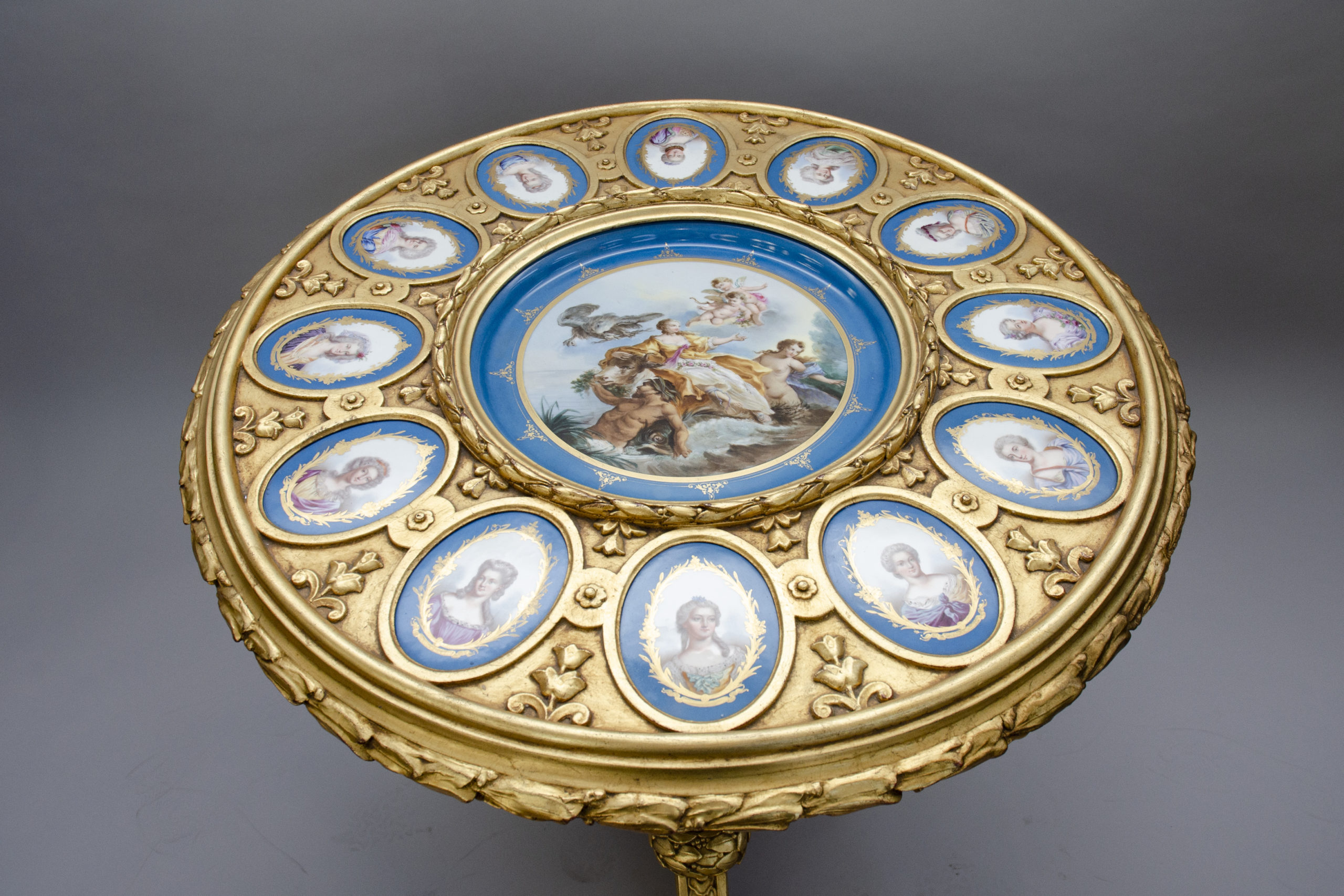
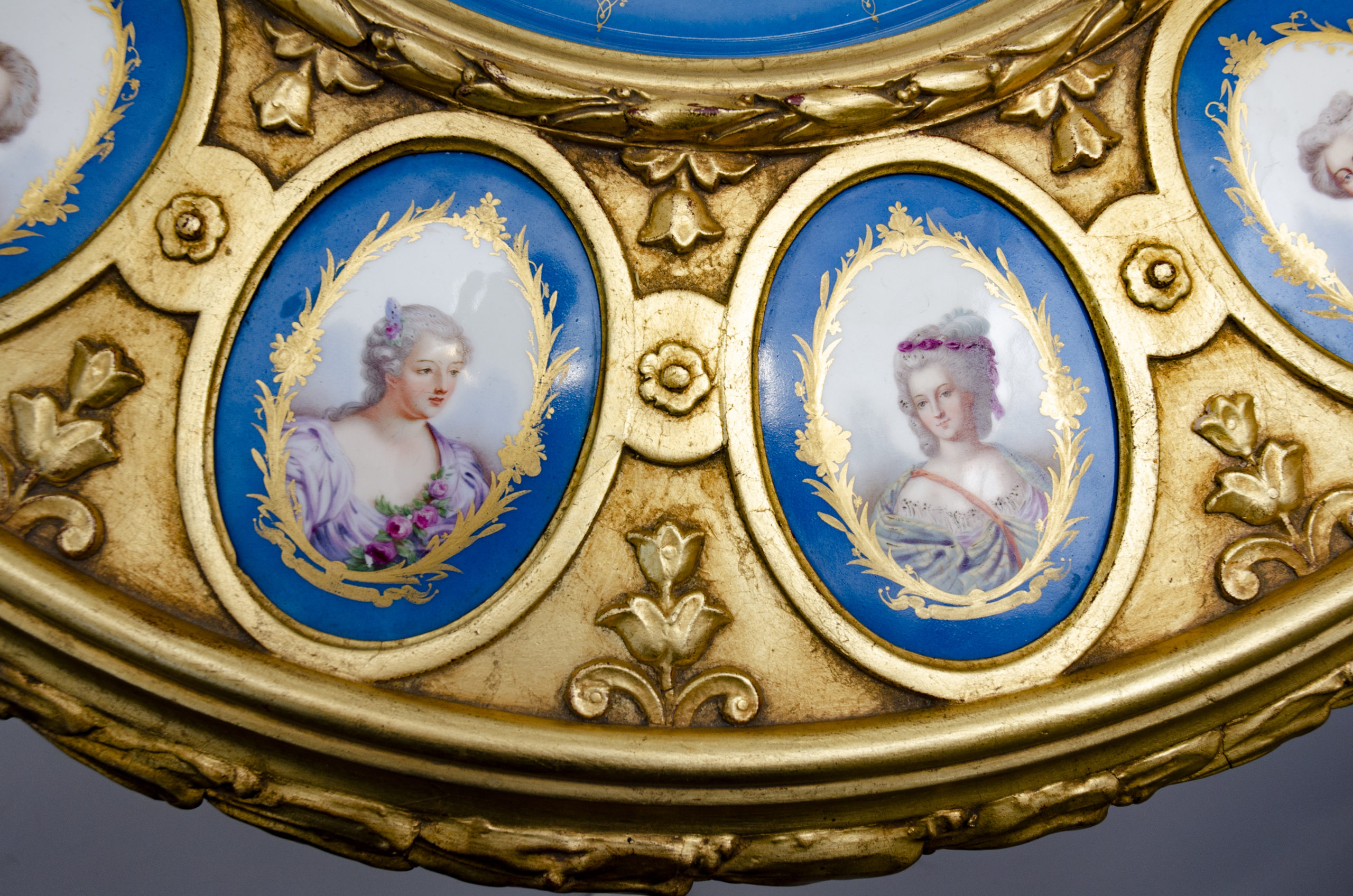
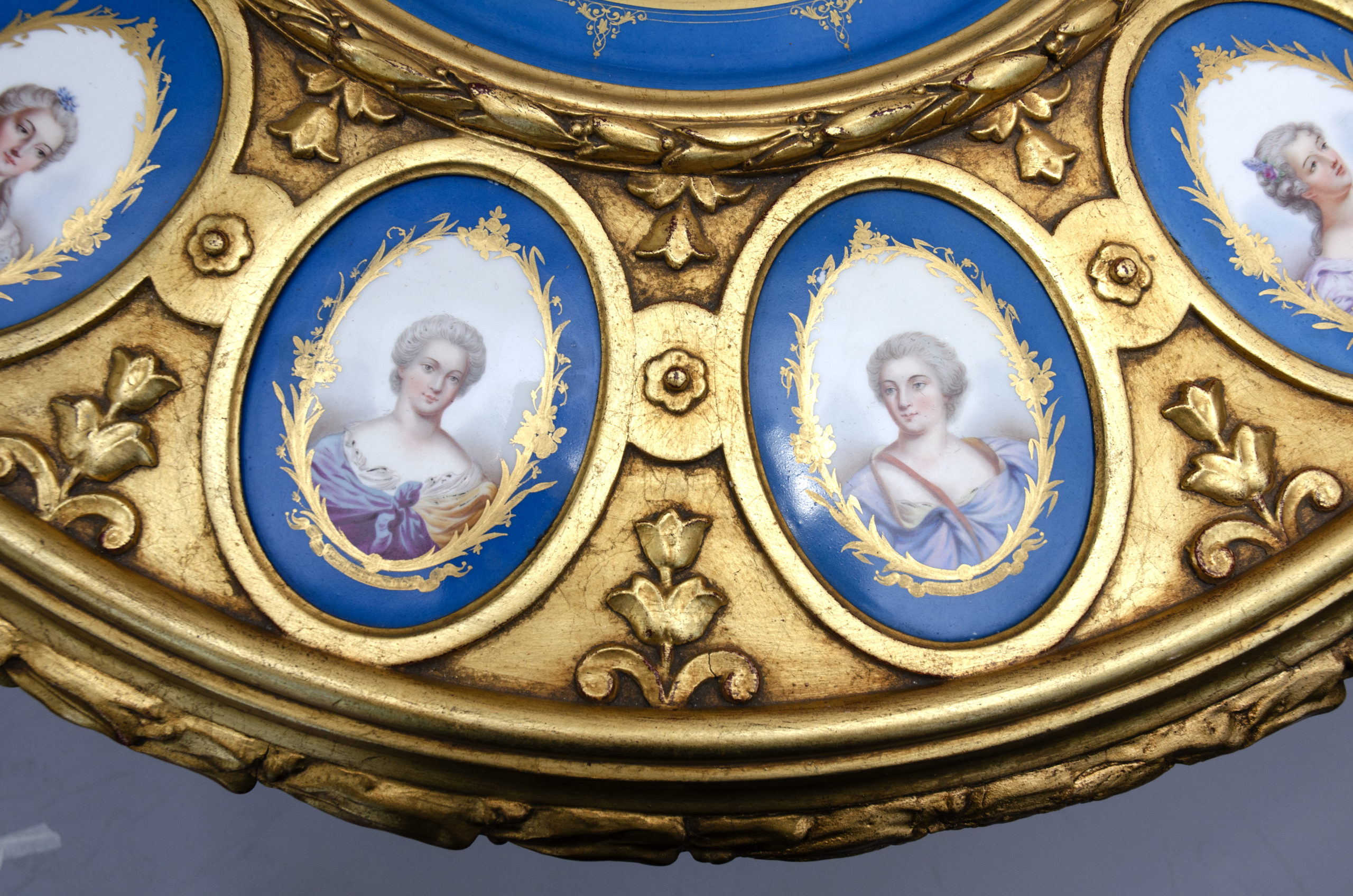
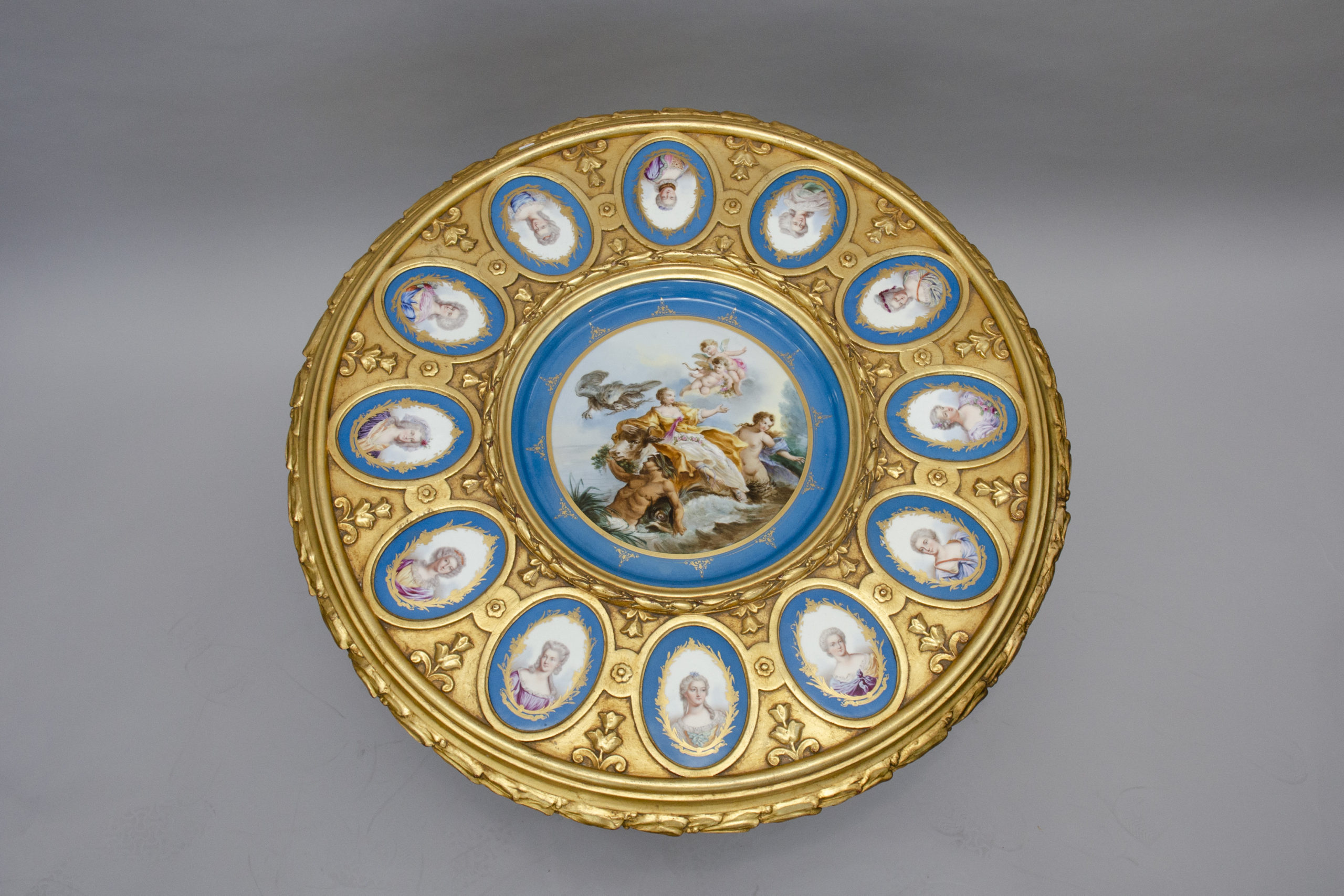
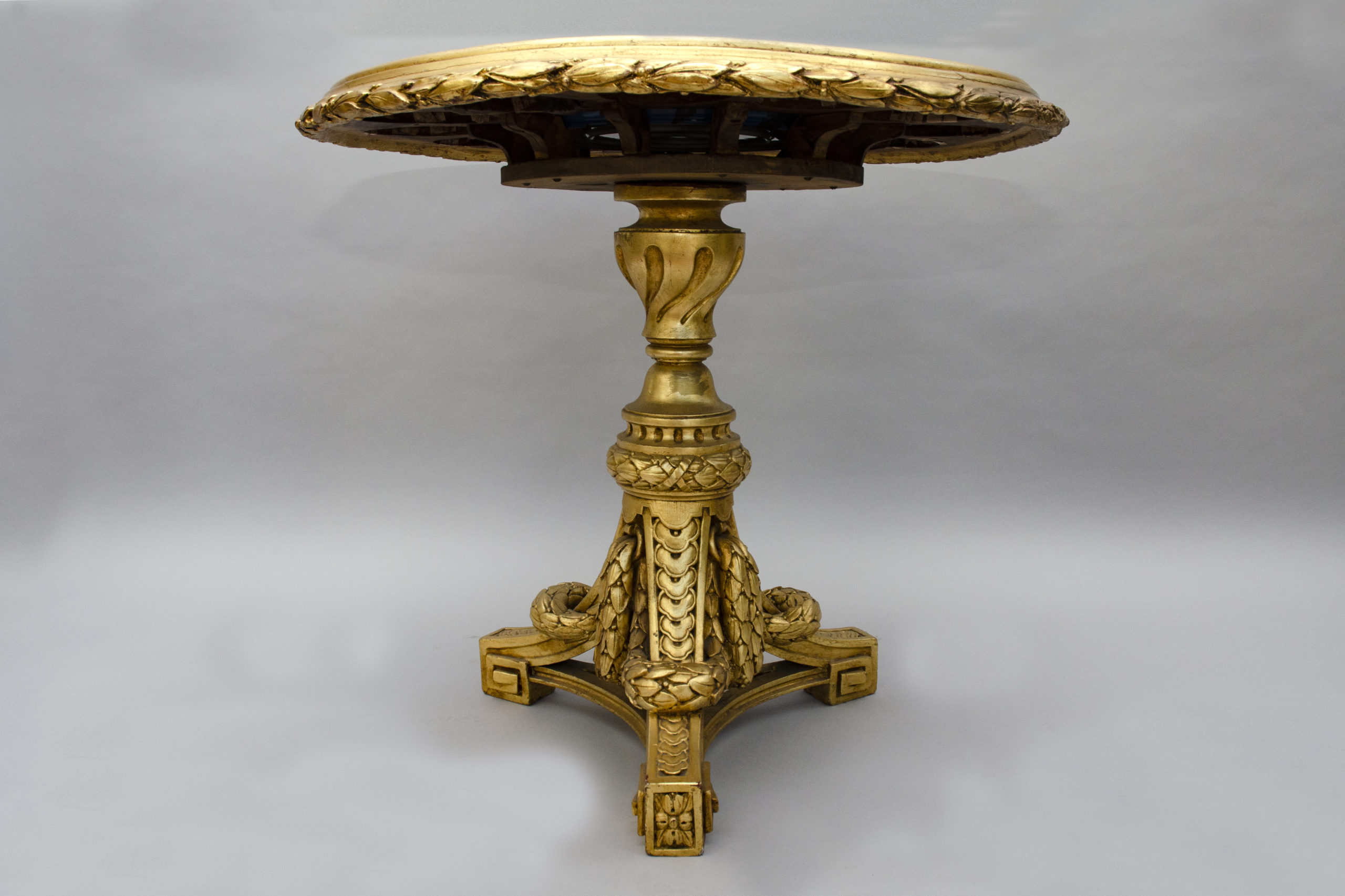
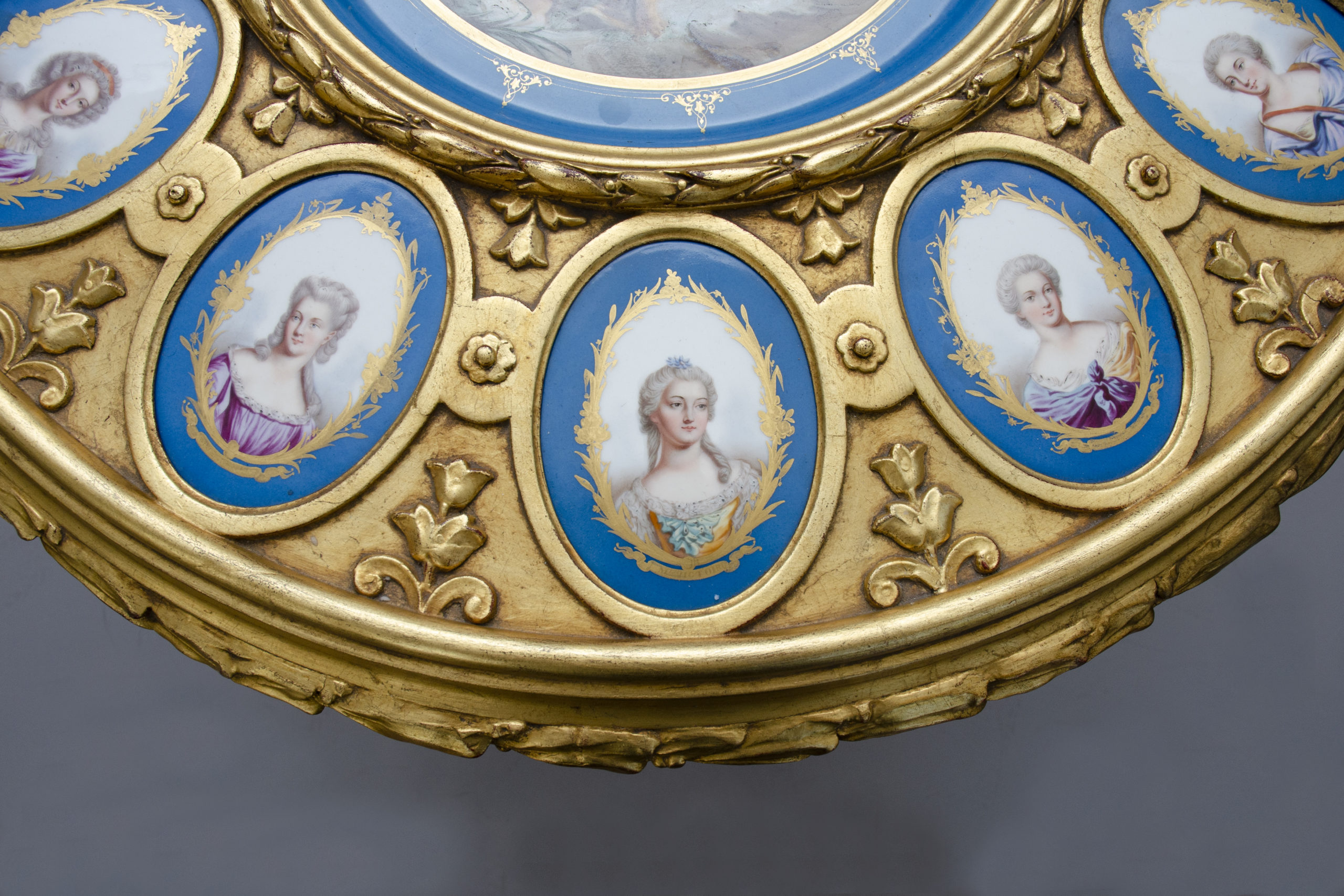
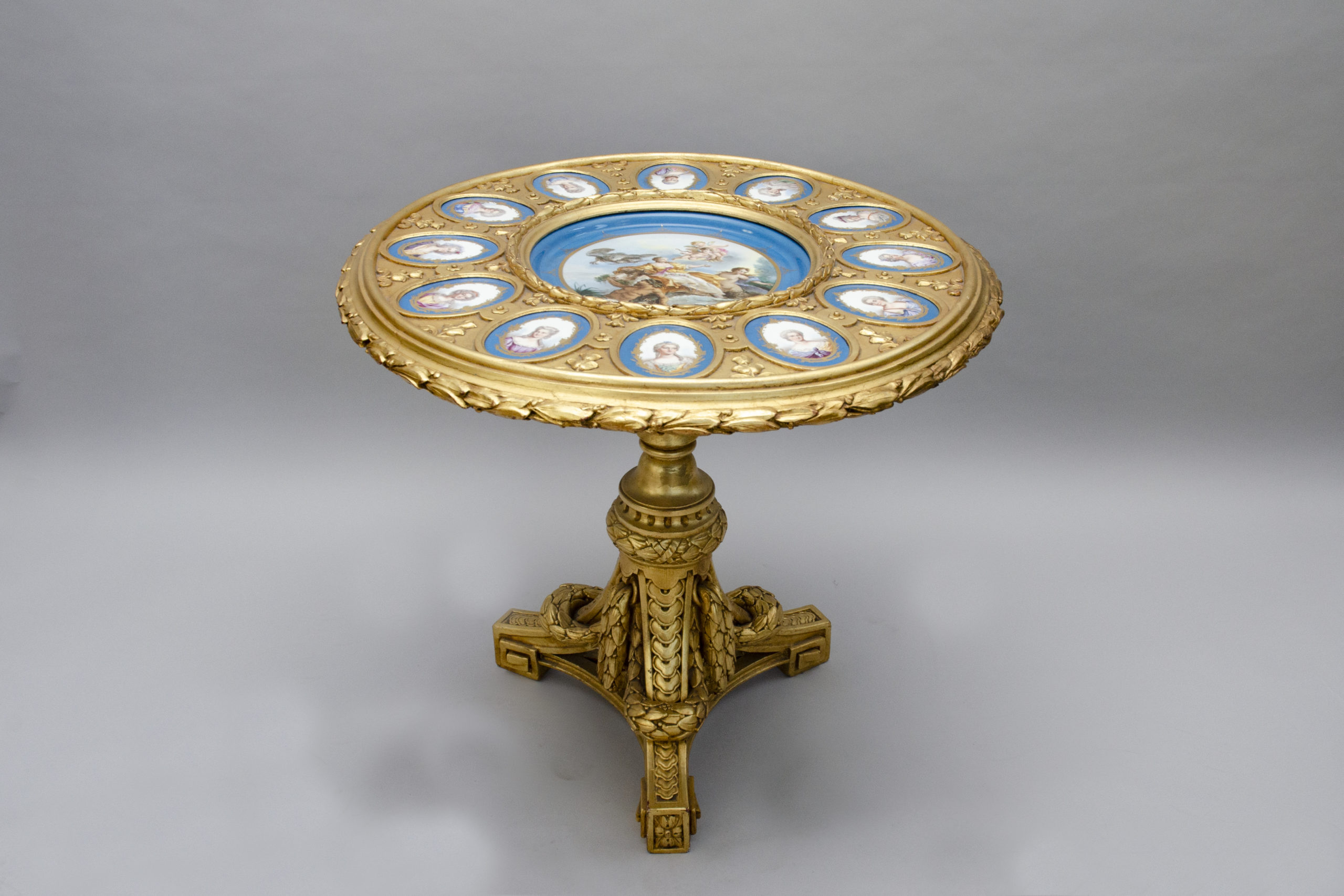
Gueridon table in gilt wood and porcelain plaques, Sèvres style
5.500€
In stock
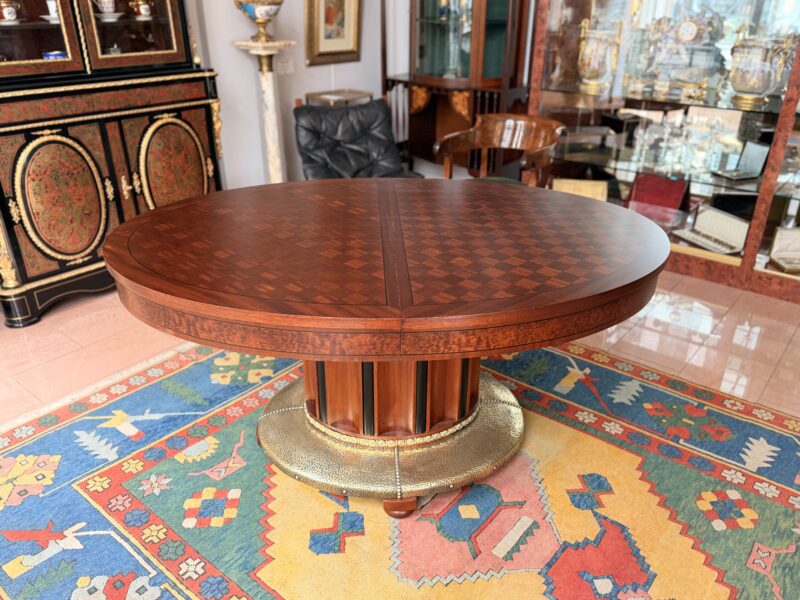
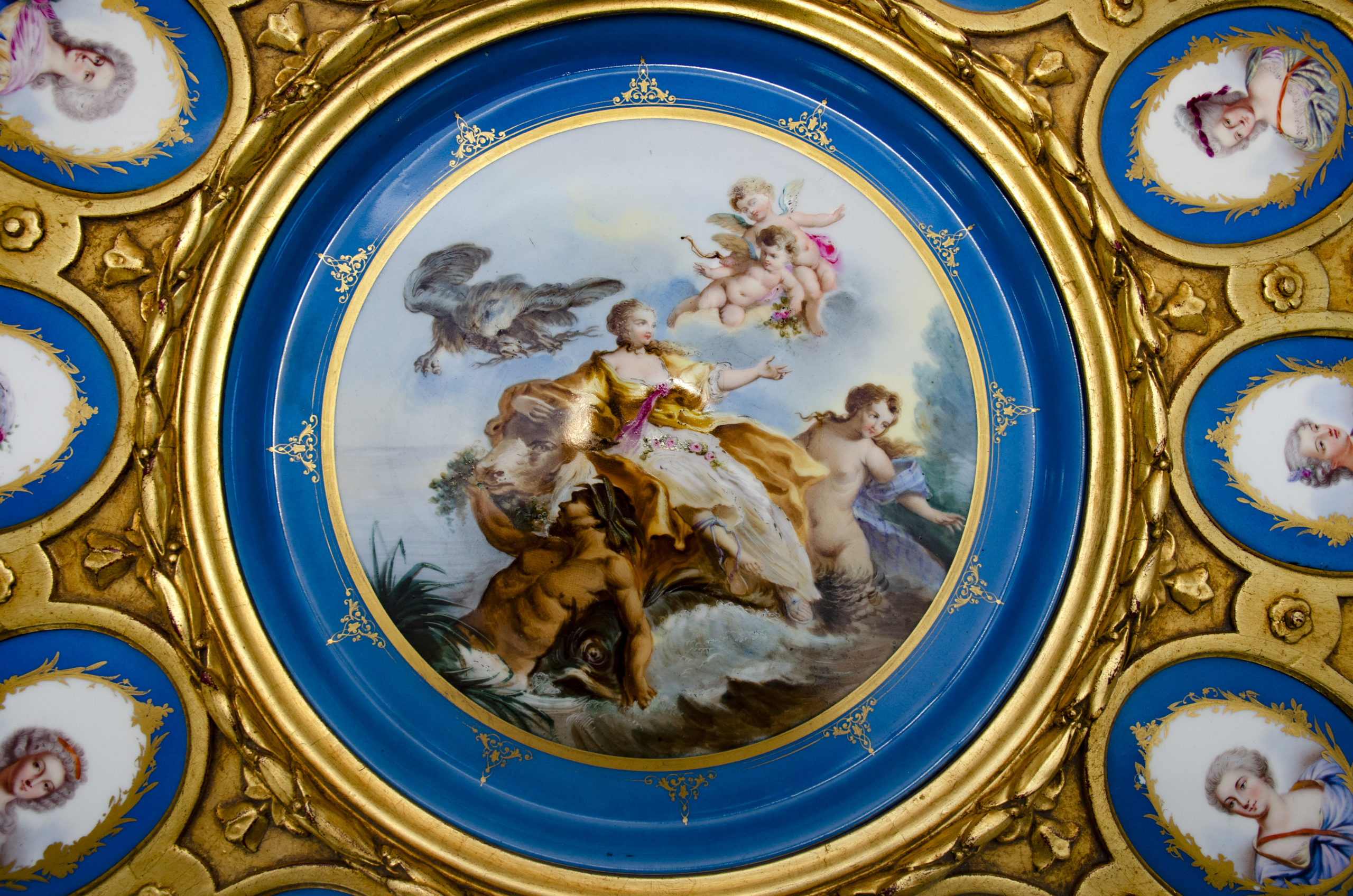
High quality gueridon table in gilt wood and Sèvres porcelain plates. In the center, the round porcelain plate depicts “The abduction of Europa” by Jean-Baptiste Marie Pierre (1750) on a blue “celeste” ground. It is in fact a glorious representation of Louis the XVI, as it is surrounded by portraits of his feminine entourage like Marie-Antoinette. The gilding of the wood is elegant and of high quality. Rare piece on the antiques market.
Size: diameter: 82cm – H76cm
French School of the mid-19th century.
This type of prestigious pedestal table was not moved freely around a room: it stood in a specific spot, often at the center of a salon or gallery, inviting the gaze rather than use, a true manifesto of political power and artisanal mastery.
The “Table des Maréchaux” is one of the most striking examples of its kind. Produced at the Sèvres Manufactory in the early 19th century during the First Empire, it was commissioned by Napoleon Bonaparte himself. Its Sèvres porcelain tabletop features medallion portraits of the Marshals of the Empire—hence its name—surrounded by military scenes and ornamentation featuring characteristic imperial motifs: laurel wreaths, eagles, and sumptuous gilding.
Lit: The myth of the abduction of Europa is one of the most famous in Greek mythology. Zeus, king of the Olympian gods, spots Europa, daughter of the Phoenician king Agenor, as she plays with her companions on the shore of Sidon. Struck by her beauty, he immediately desires to seduce her.
To approach her without frightening her—and without arousing the jealousy of his wife Hera—Zeus transforms himself into a bull of immaculate whiteness, of extraordinary gentleness and beauty. The animal mingles with Agenor’s herd of oxen and gently approaches Europa. Intrigued and charmed by this beast so beautiful and peaceful, the young woman strokes its flank, weaves garlands of flowers around its neck, and finally climbs onto its back, inviting her companions to do the same.
It was then that Zeus sprang into action. With a thunderous gallop, he charged toward the sea and plunged into it, carrying Europa alone on his back, terrified and clinging to the bull’s horns. The two crossed the Mediterranean to the island of Crete, where Zeus resumed his divine form. He united with Europa in a cave, beneath plane trees which, it is said, became immortal as a testament to this union.
This founding myth has endured through the centuries: it gives the European continent its name and, depending on the interpretation, symbolizes the meeting of East and West, the irresistible power of divine desire, or the transition of a civilization toward a new world.
In stock