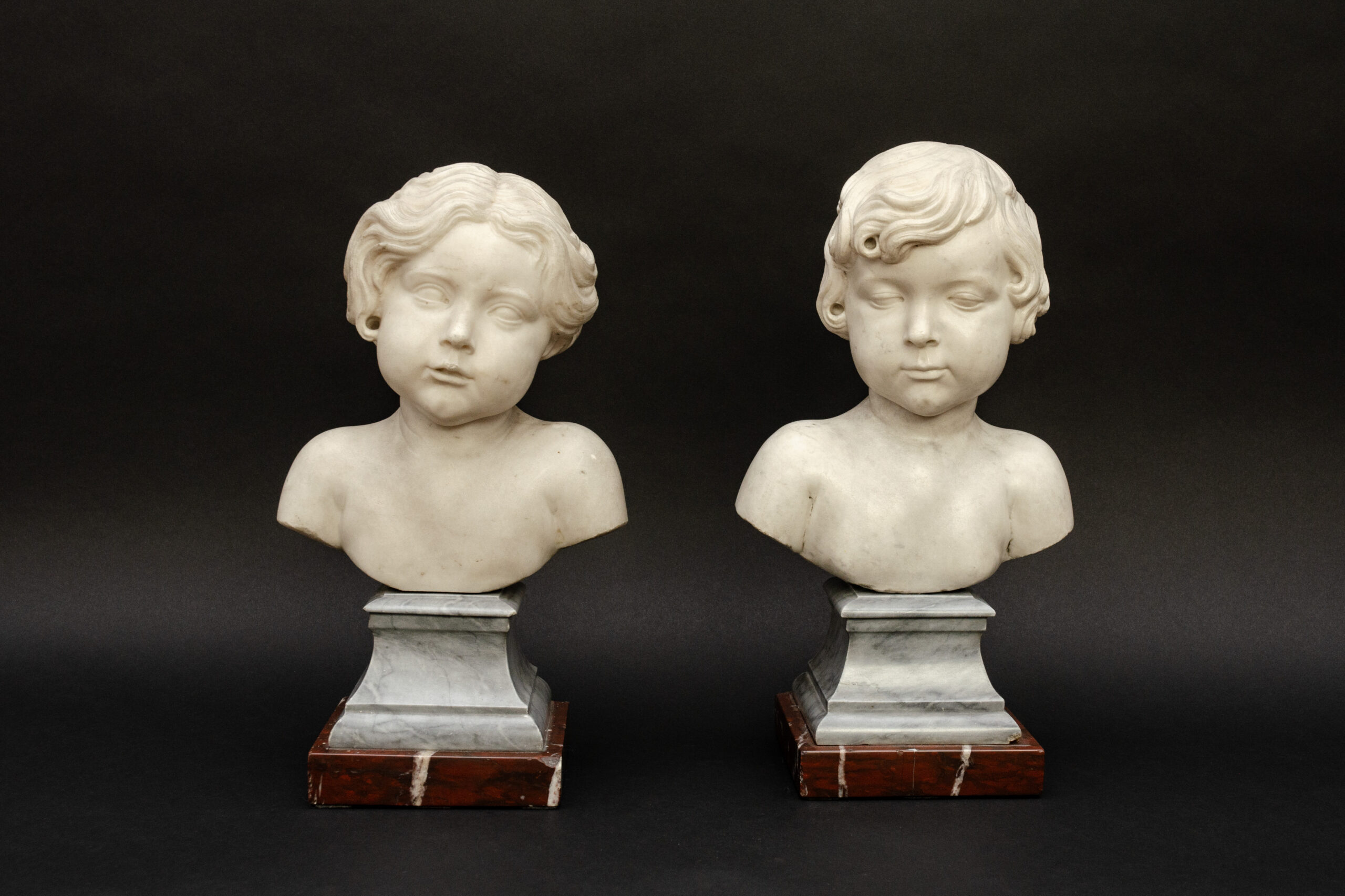
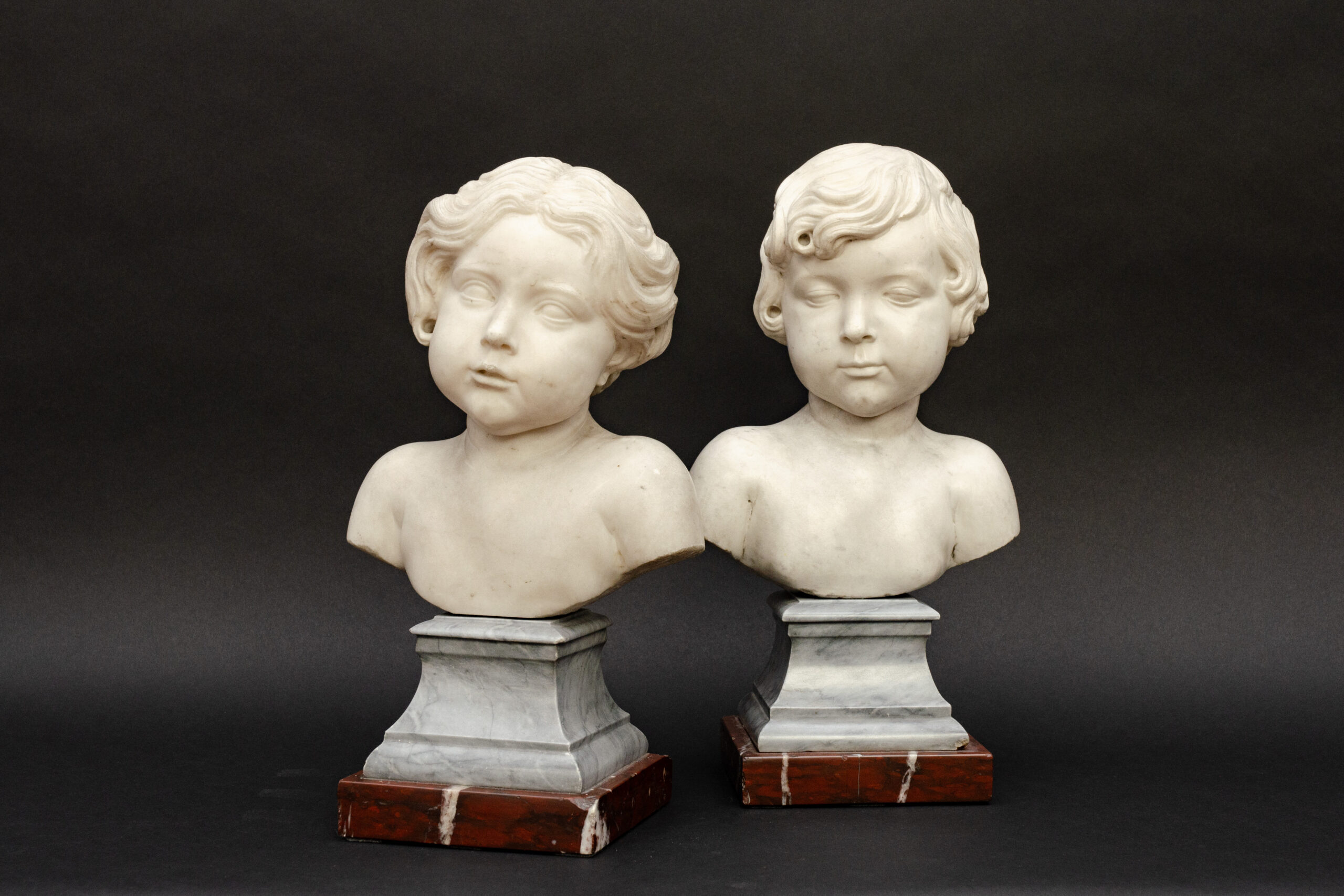
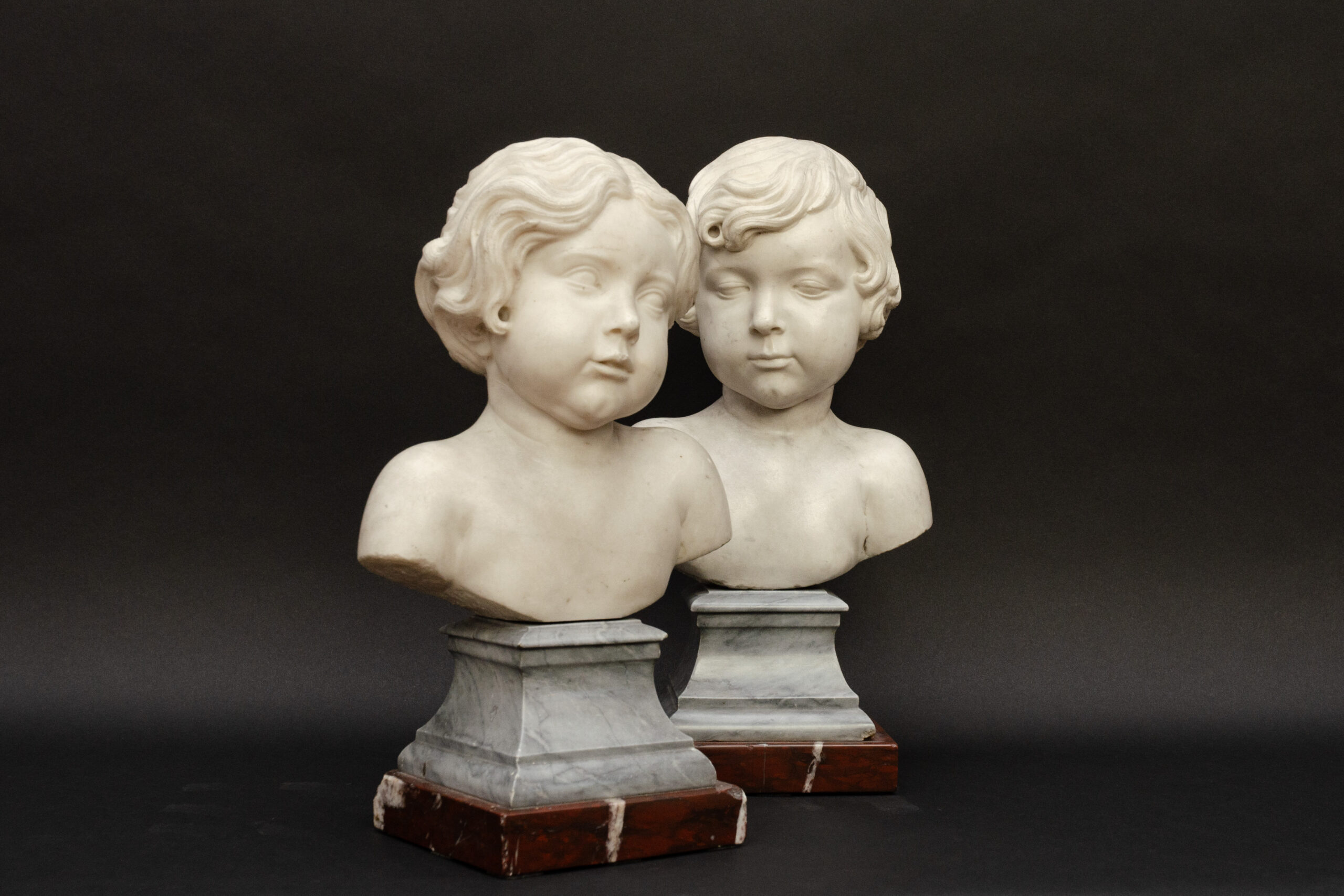
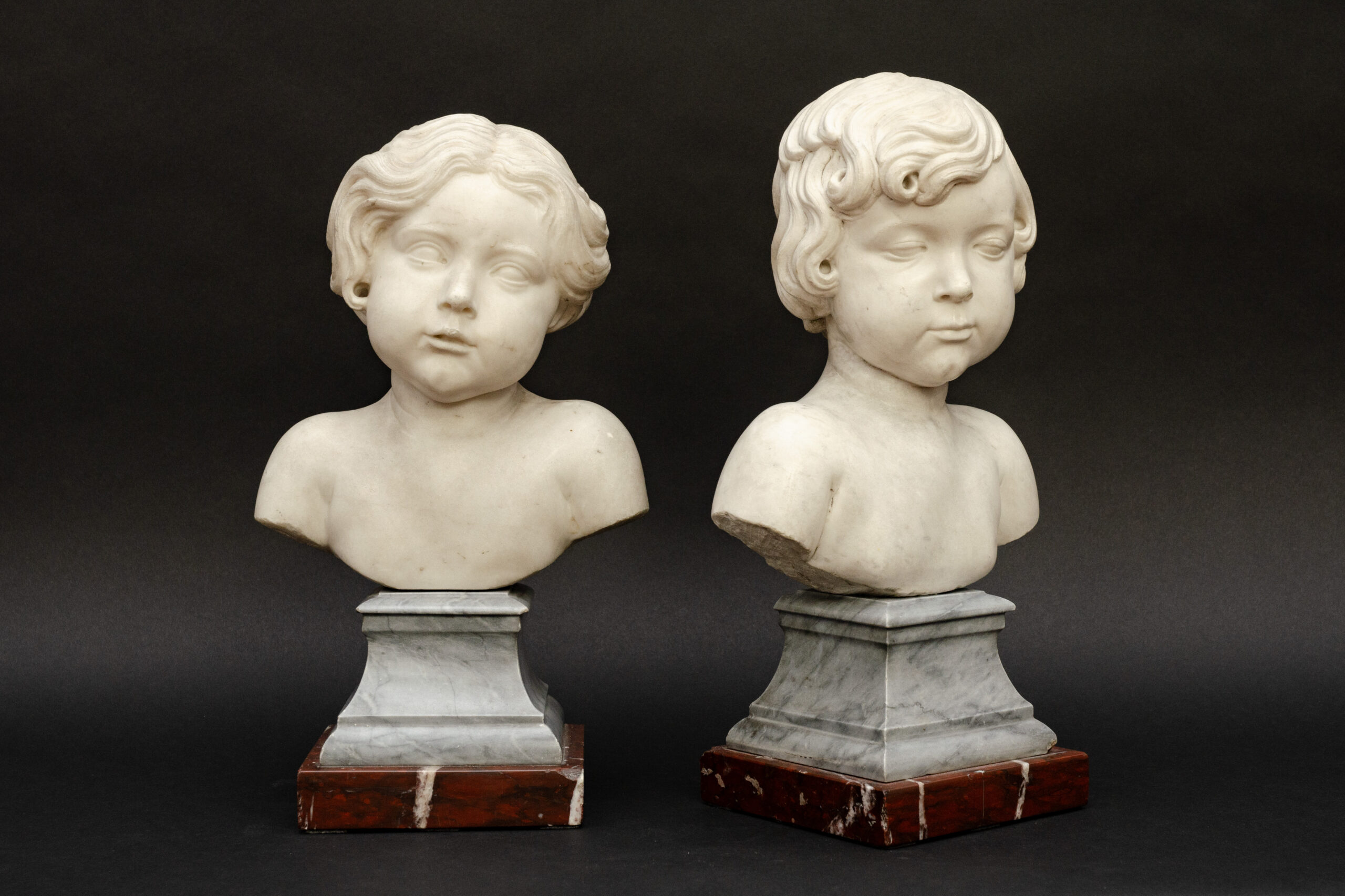
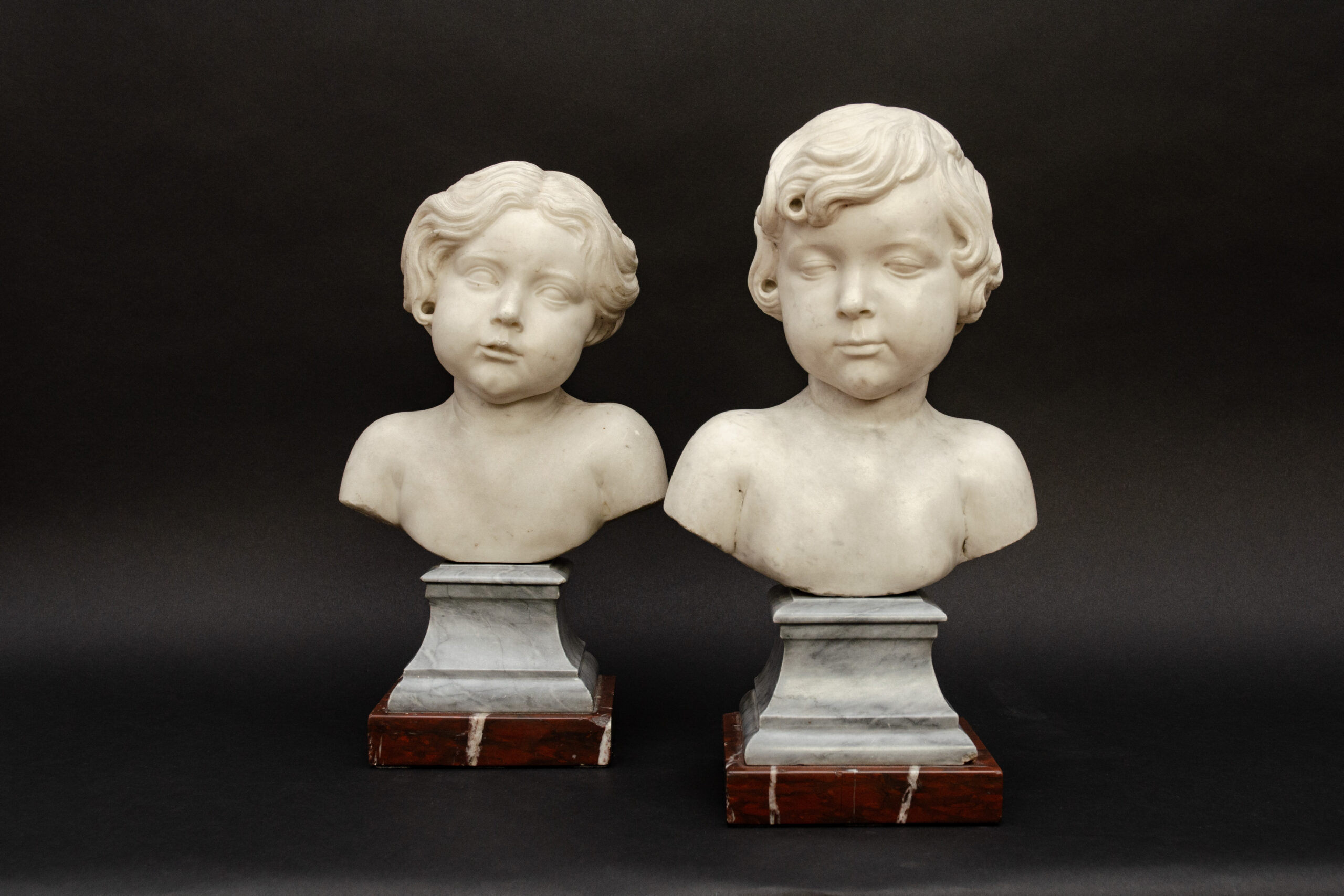
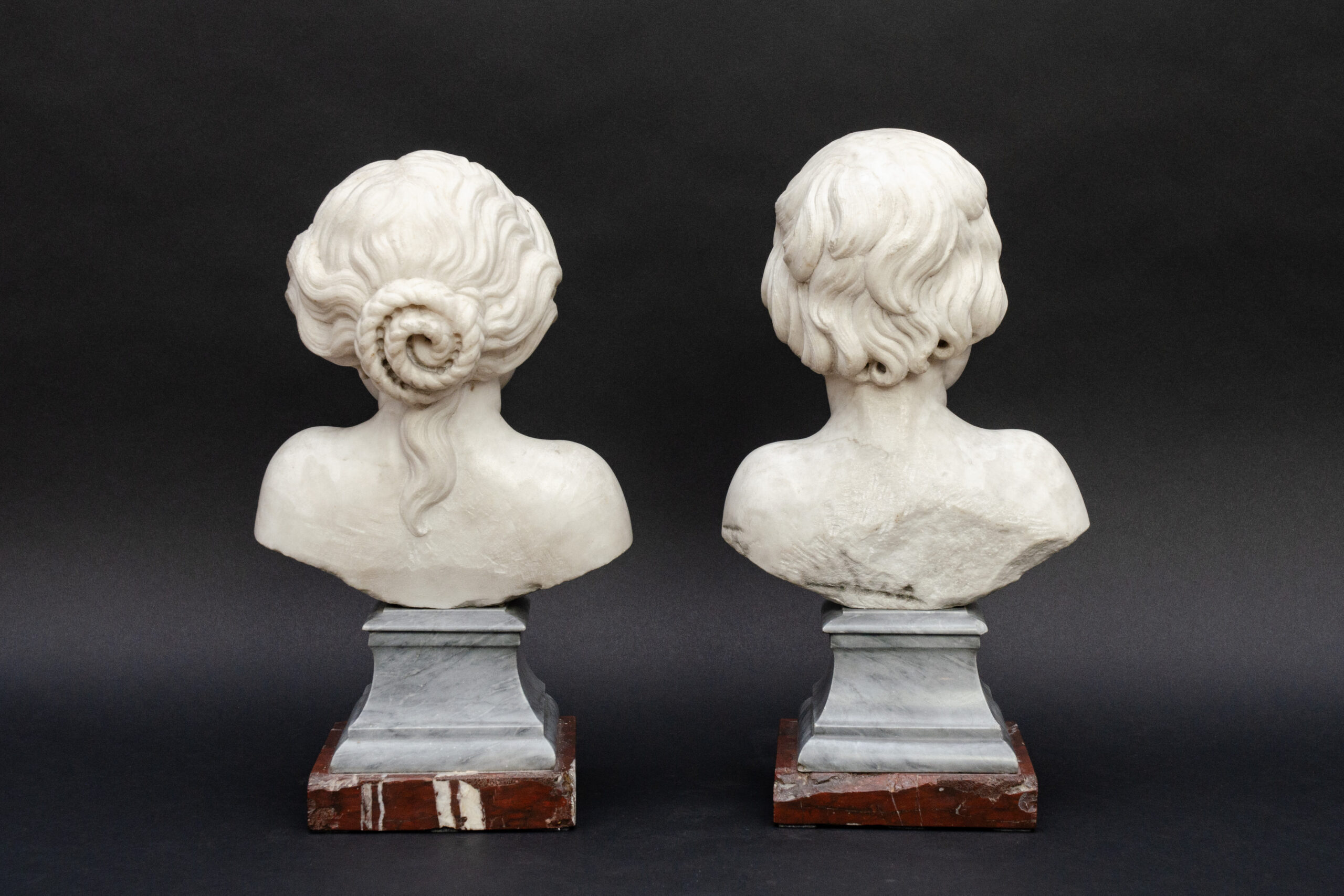
A pair of marble busts of children, circle of Alessandro Algardi (Bologna 1595 – Rome 1654)
16.000€
In stock
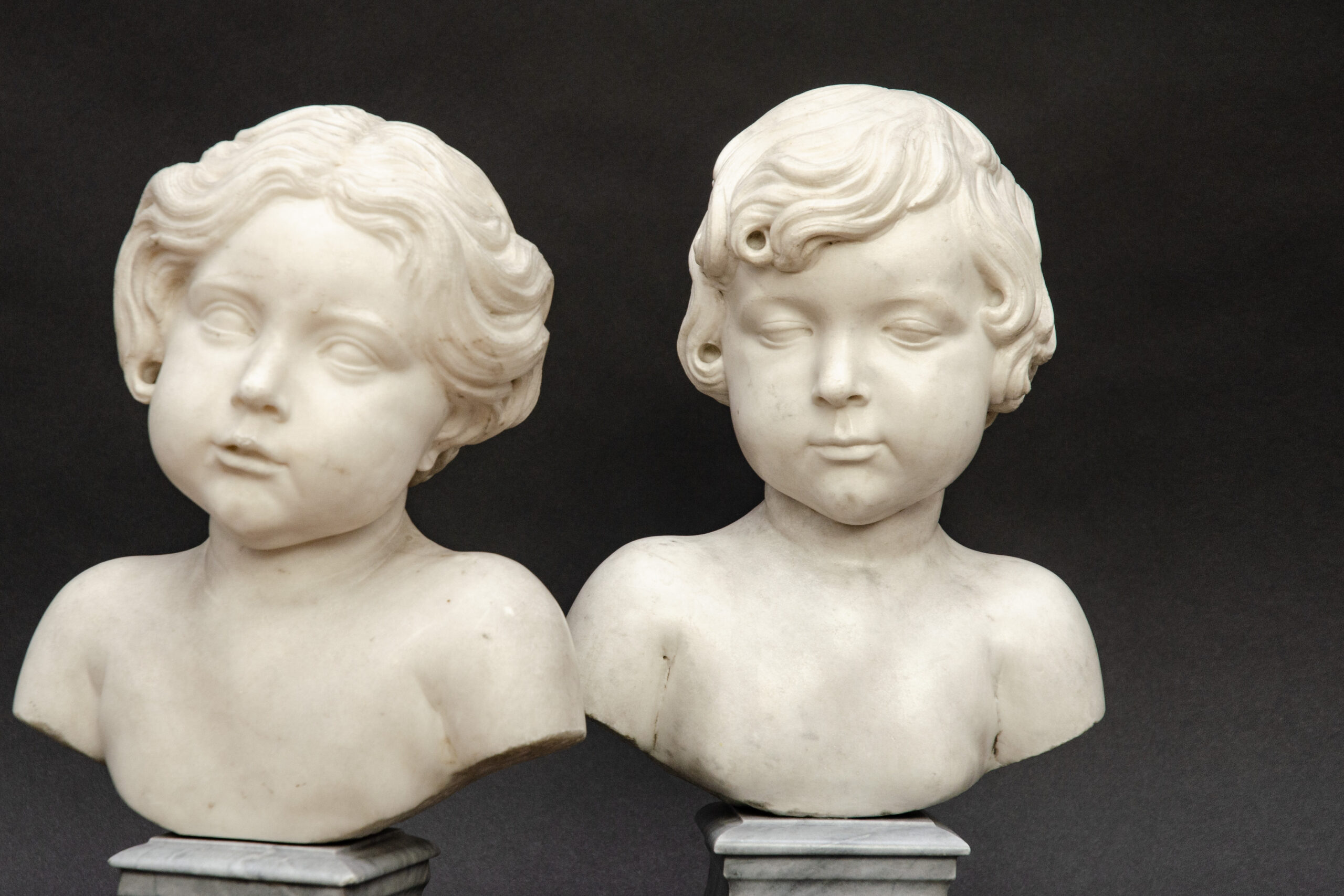
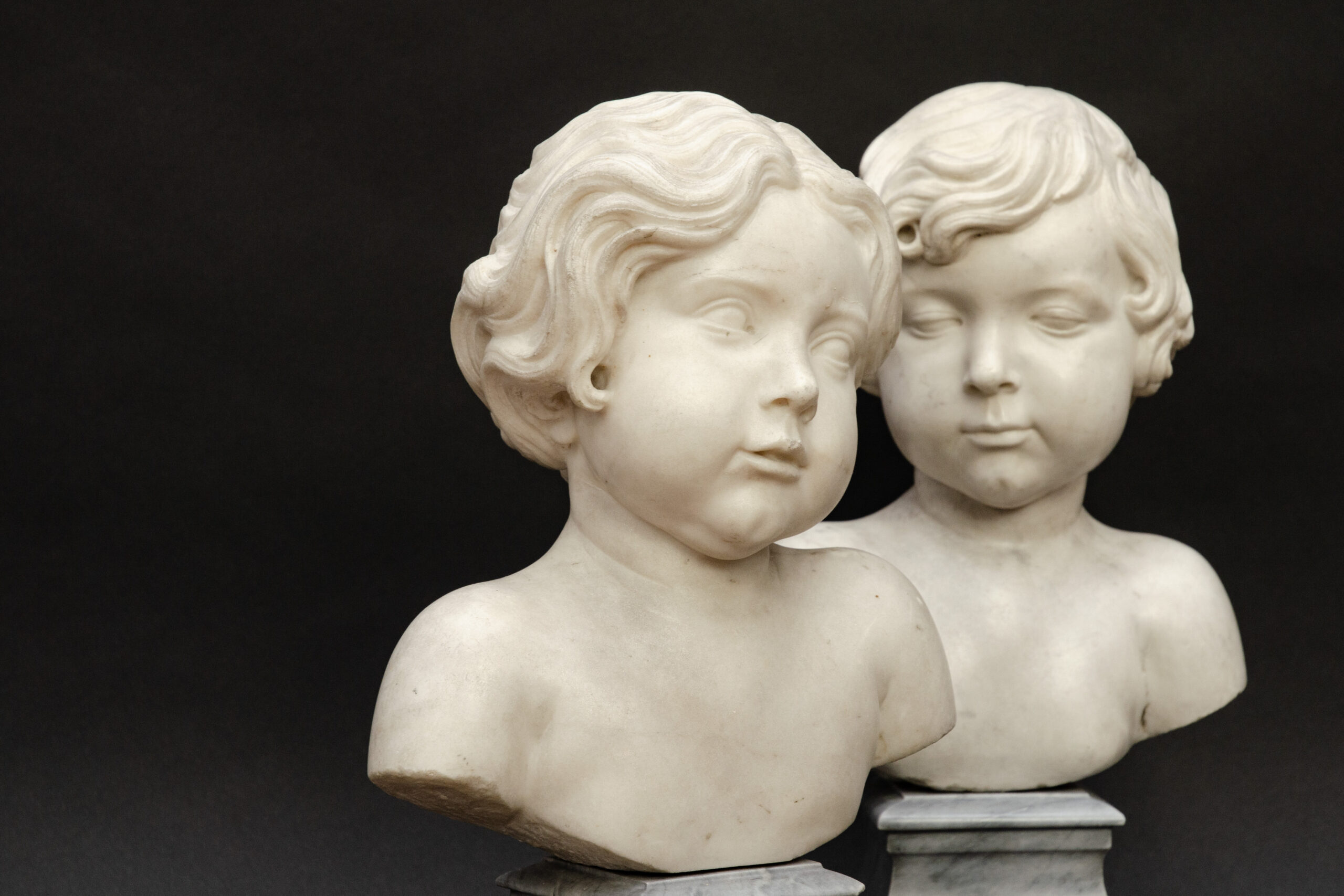
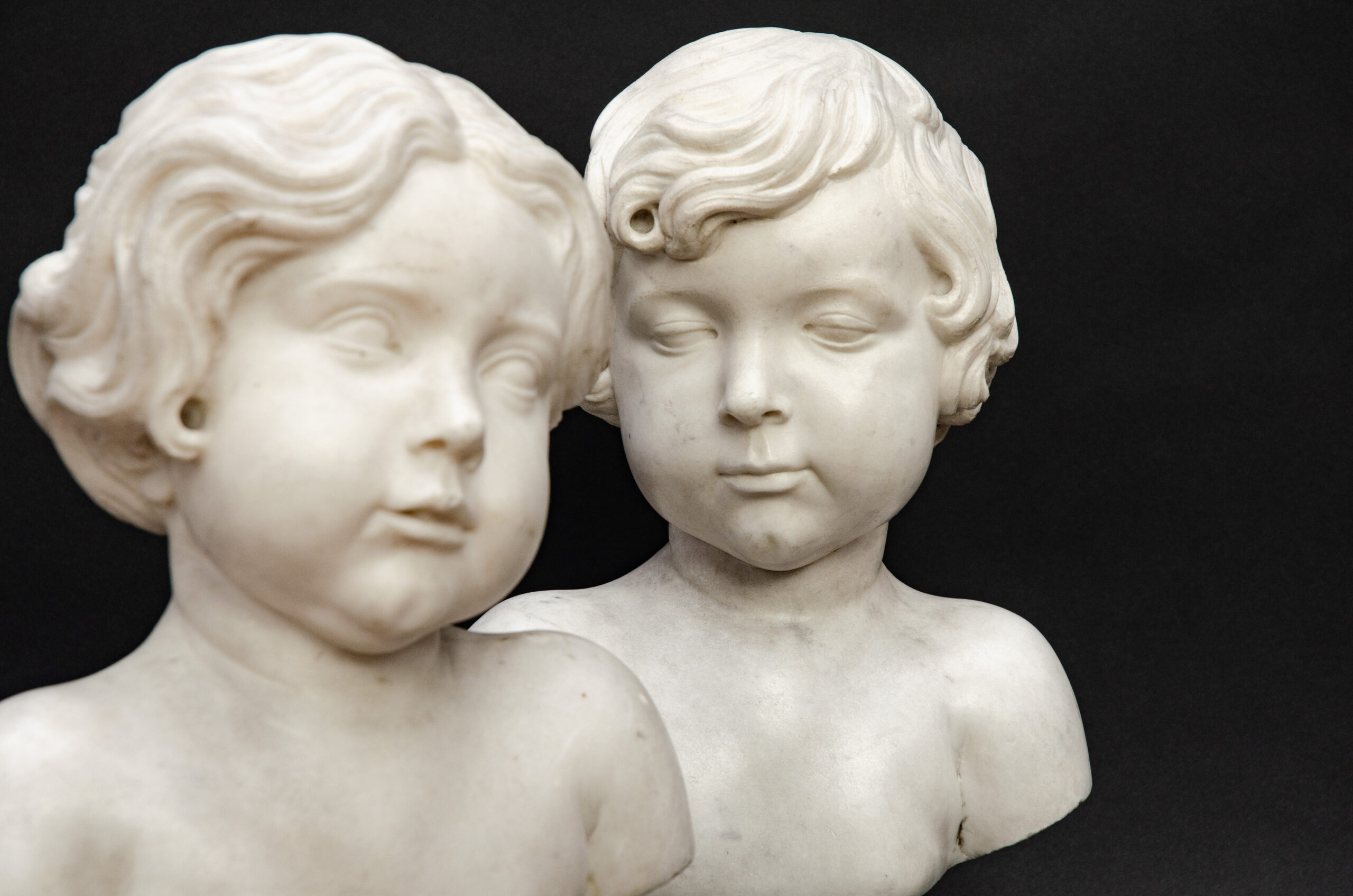
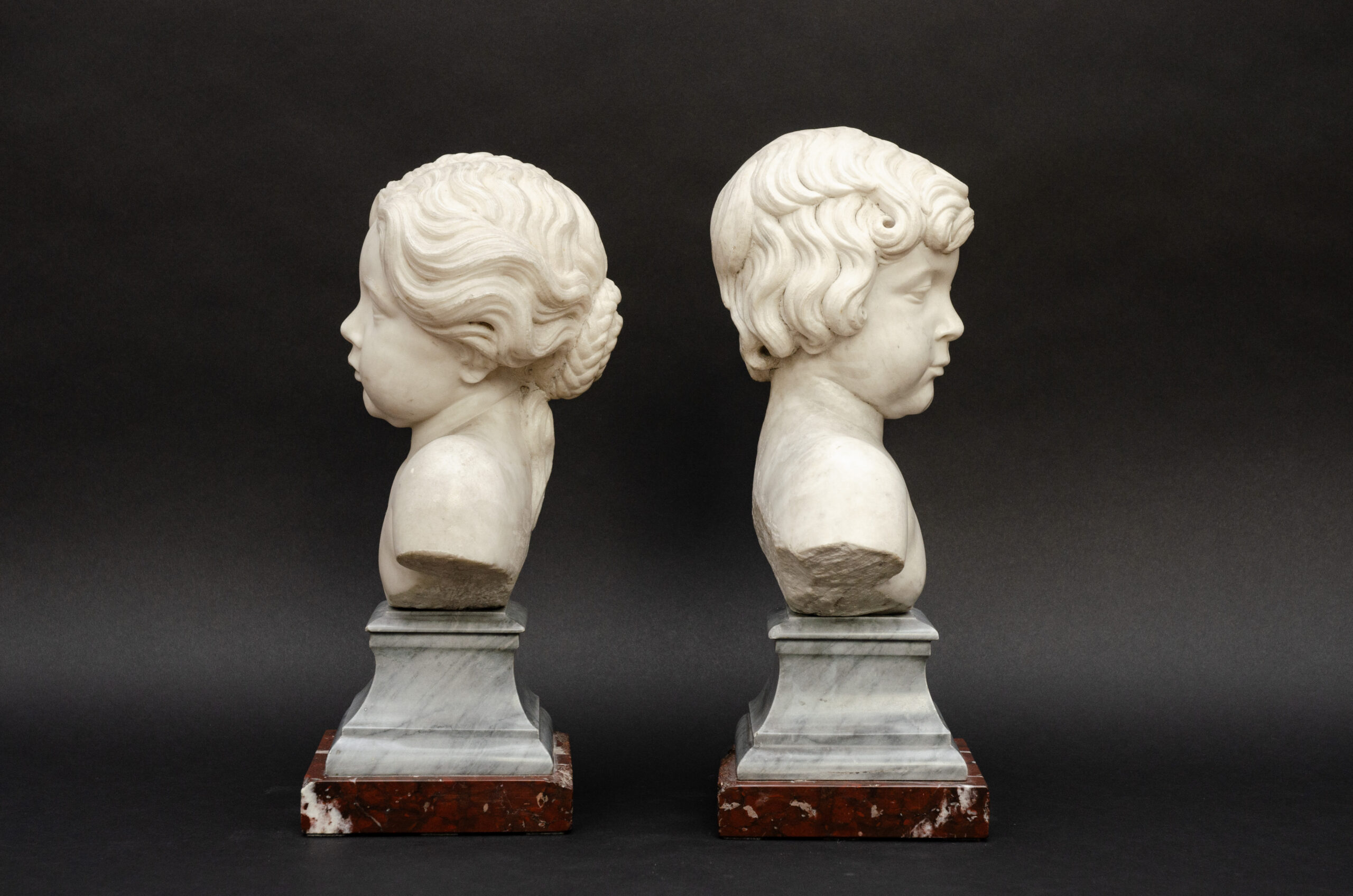
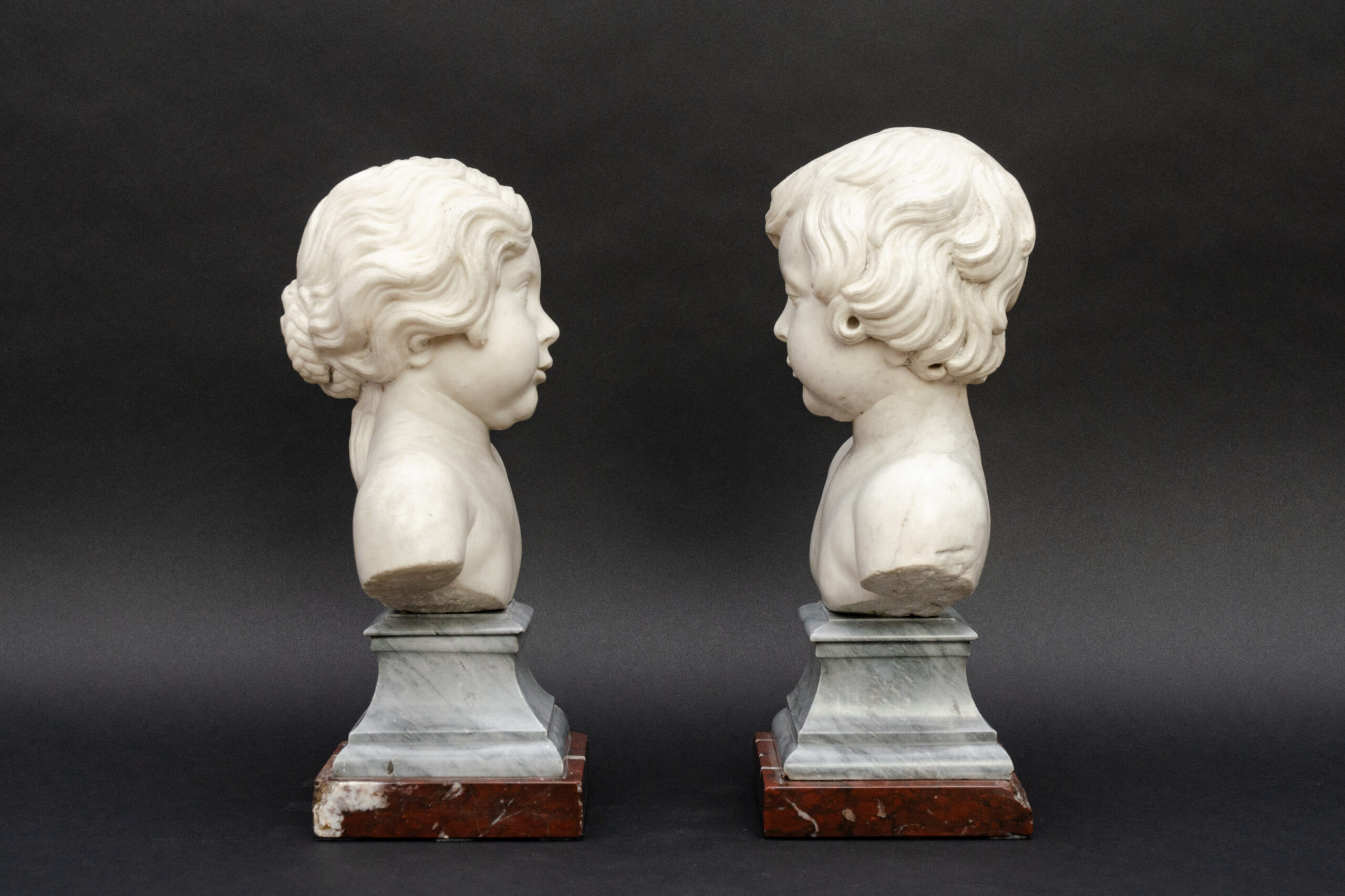
A superb pair of white marble busts of children in the Italian Baroque style. Bare-chested, with the head slightly tilted, eyes half-closed and mouth slightly parted, this type is very common in Roman Baroque sculpture, often referred to as the ‘sleeping child’ or ‘dreaming child’. This kind of idealised child’s head, without any attributes, was used for decorative purposes. The plinths, a square base in red marble veined with white, surmounted by a grey pedestal are probably the 19th century. In fine condition, with a patina consistent with the period.
Size: H 38 and 39 cm – shoulder width 21 cm – base 15 cm x 15 cm
Rome, second half of the 17th century.
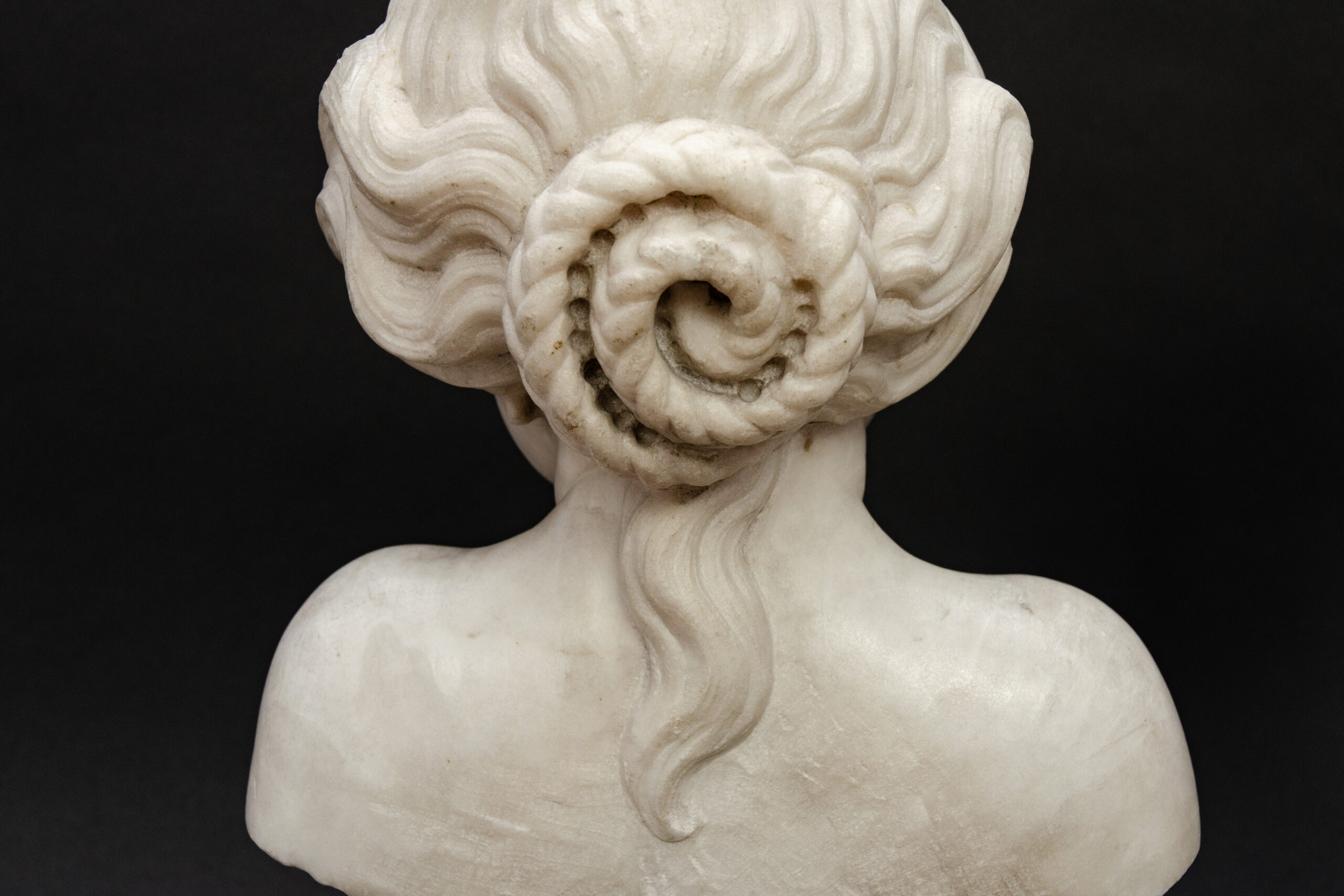
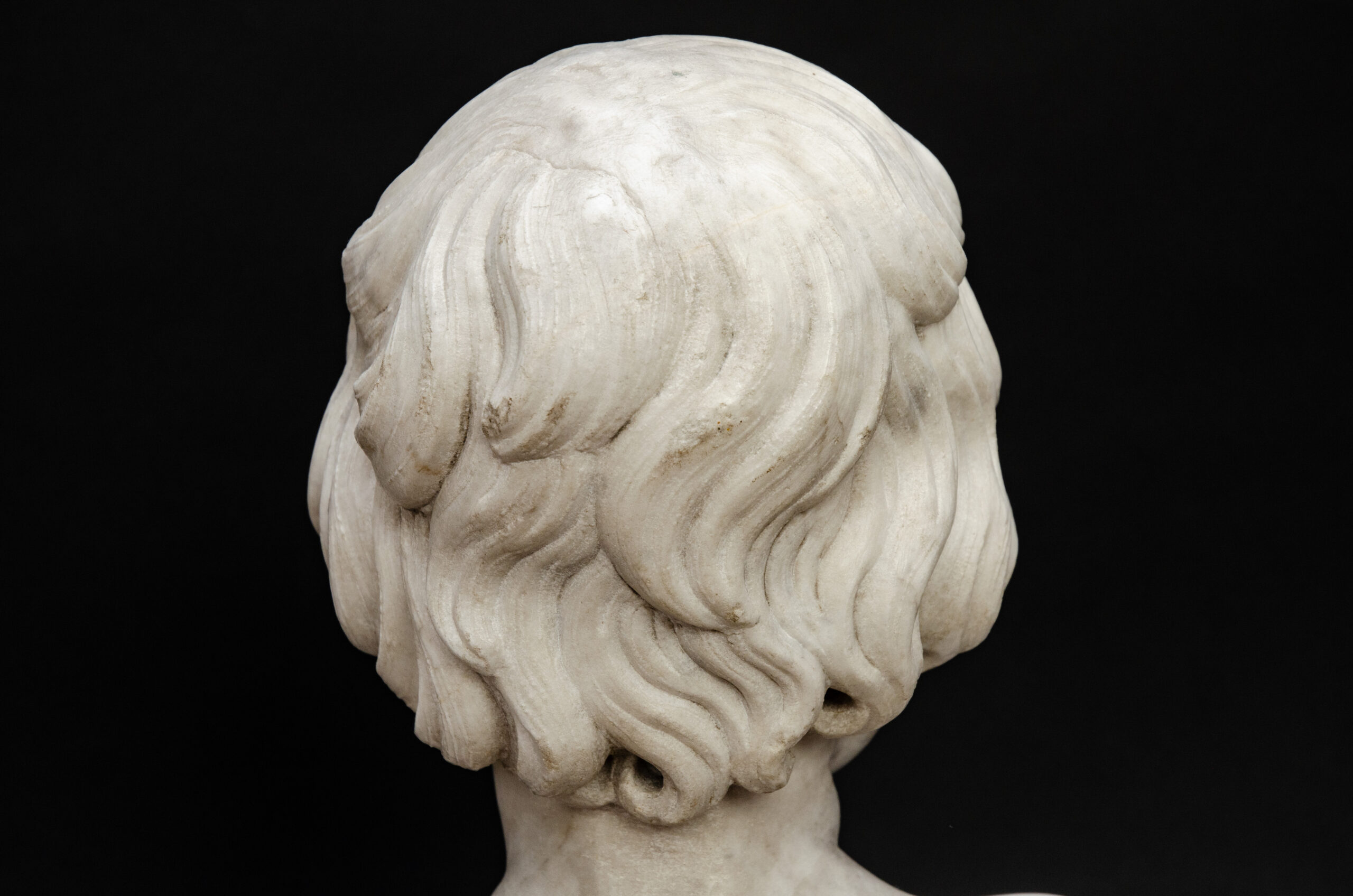
The technique used for the hair is an important chronological indicator, as on both heads there are small curly locks carved with a trephine (the small round hole visible at the centre of the curl). This ‘spiral curl carved with a trephine’ is a highly characteristic technical signature of Roman workshops in the second half of the 17th century; it is found amongst the circle of Alessandro Algardi and, more broadly, amongst Roman marble carvers trained in this tradition (Ercole Ferrata, Domenico Guidi, etc.). The little girl’s tight rolled bun is another hairstyle typical of this period. The flesh is rendered with a rather full and softened modelling (plump cheeks, a rounded chin); the almond-shaped eyes, set slightly deep beneath heavy eyelids, are very ‘Algardian’ in their restrained naturalism, less theatrical than Bernini’s but just as sensitive in the rendering of the skin.
Biography: Alessandro Algardi was born in Bologna in 1598. He initially trained as a painter and draughtsman at the Accademia degli Incamminati, the academy founded by the Carracci family, where he received a classical education based on the study of nature and antiquity – a legacy that would have a lasting influence on his sculptural style. He then turned to sculpture, likely under the influence of Ludovico Carracci, before leaving Bologna to further his training. After a spell in Mantua, where he worked for Duke Ferdinando Gonzaga and studied the ducal collections of ancient sculpture, Algardi settled permanently in Rome around 1625. His early days in Rome were modest: he initially worked as a restorer of antiquities and produced silver figurines and small decorative objects, in the shadow of the all-powerful Gian Lorenzo Bernini, who then dominated the Roman art scene during the pontificate of Urban VIII (Barberini). Algardi’s career took a decisive turn with the accession of Pope Innocent X Pamphili in 1644. Unlike his predecessor, Innocent X was more reserved towards Bernini and favoured Algardi, who then became Cavalier Bernini’s main rival in Rome. It was during this period that he produced his absolute masterpiece: the monumental marble relief depicting the Encounter between Saint Leo the Great and Attila, in St Peter’s Basilica (1646–1653), a composition of exceptional narrative scope and technical virtuosity for a bas-relief. Algardi also excelled in sculpted portraiture, where his approach differed from Bernini’s in its more restrained naturalism and his careful, understated observation of facial features, less theatrical and less dynamic than the Bernini style. His bust of Pope Innocent X (and his full-length statue in Bologna) exemplifies this more classical and measured style. He also produced a great deal of funerary and decorative sculpture, running a major workshop that employed numerous collaborators and assistants, thereby helping to spread his stylistic vocabulary throughout Roman sculpture of the second half of the 17th century. Alessandro Algardi died in Rome in 1654. He is now regarded, alongside Bernini and François Duquesnoy, as one of the three great figures of Roman Baroque sculpture, embodying a more classicizing, restrained and ‘Bolognese’ Baroque style in contrast to Bernini’s dramatic exuberance.
In stock
Additional information
| Height | 38cm |
|---|---|
| Shoulder width | 21cm |
| Base | 15x15cm |