“Cicéron” marble and bronze clock, Grandperrin in Paris
Price on request
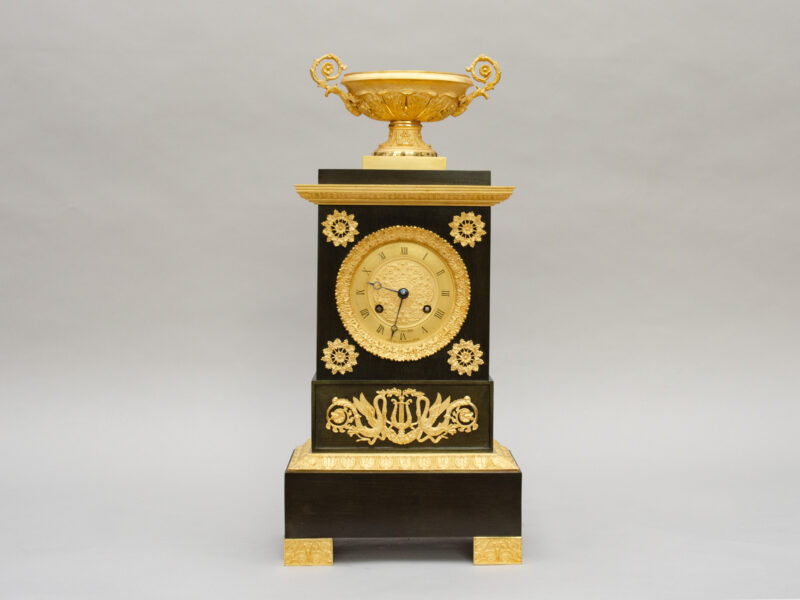
Contact usA fine neoclassical clock in ‘Griotte’ red marble and patinated bronze, surmounted by a bronze bust depicting Cicero, identified by the inscription ‘CICÉRON’ engraved on its bronze plinth. The architecturally designed body of the clock, in the shape of a ‘boundary stone’, rests on a plinth, which in turn stands on chiselled bronze mouldings featuring stylised acanthus leaf motifs. The top is adorned with a bronze cornice decorated with a frieze of leaves. The dial is in bronze and enamel, with black Roman numerals, signed by Ferdinand Grandperrin, 394 Rue Saint-Honoré, surrounded by a gilded bronze rim and a domed glass bezel. The marble shows signs of a restoration. The movement is revised and in working condition.
Size: H 47 cm – base W 20.5 cm x 11.5 cm
French school, circa 1840–1850.
The bust of Cicero, in bronze with a dark brown patina, displays a realistic style characteristic of 19th-century archaeological taste: chiselled features, partial baldness, and antique drapery revealing the shoulders.
Lit: Marcus Tullius Cicero (106–43 BC) was one of the most influential figures of ancient Rome: a lawyer, orator, philosopher and statesman. Consul in 63 BC, he foiled Catiline’s conspiracy and became the most celebrated voice of Latin rhetoric. His speeches (the Catiline Orations, the Philippics) and his philosophical treatises (De Officiis, De Republica) shaped Western political and moral thought for centuries. A tireless defender of the Roman Republic against the rise of personal power, he was proscribed and executed on the orders of Mark Antony in 43 BC. In the eyes of the nineteenth century, Cicero embodied the figure of the orator-citizen, the wise republican and the quintessential Latin humanist — a model particularly prized in a France which, after the Revolution, was seeking ancient references to legitimise its own civic ideals.
Lit: Ferdinand-Joseph Grandperrin, son of the Parisian watchmaker Nicolas-François Grandperrin and Anne-Antoinette-Victoire Lherminier, took over his father’s business in the late 1830s and quickly built up a clientele. Based at 394 Rue Saint-Honoré, he gained a certain reputation. In September 1842, he married Éléonore-Pauline Meugnot, probably the daughter of the watchmaker Joseph-Julie-Alexandrine Meugnot, who was recorded in the 1830 census at Place de l’Oratoire. Grandperrin became famous for his innovative work, as well as for the perfection of his movements.